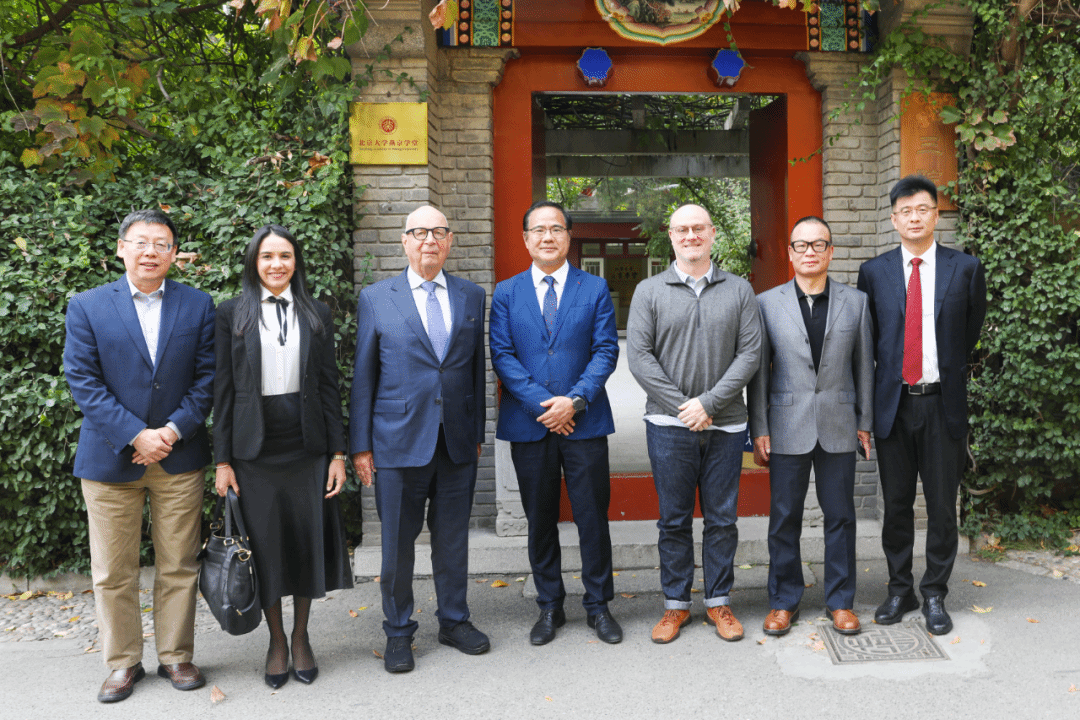
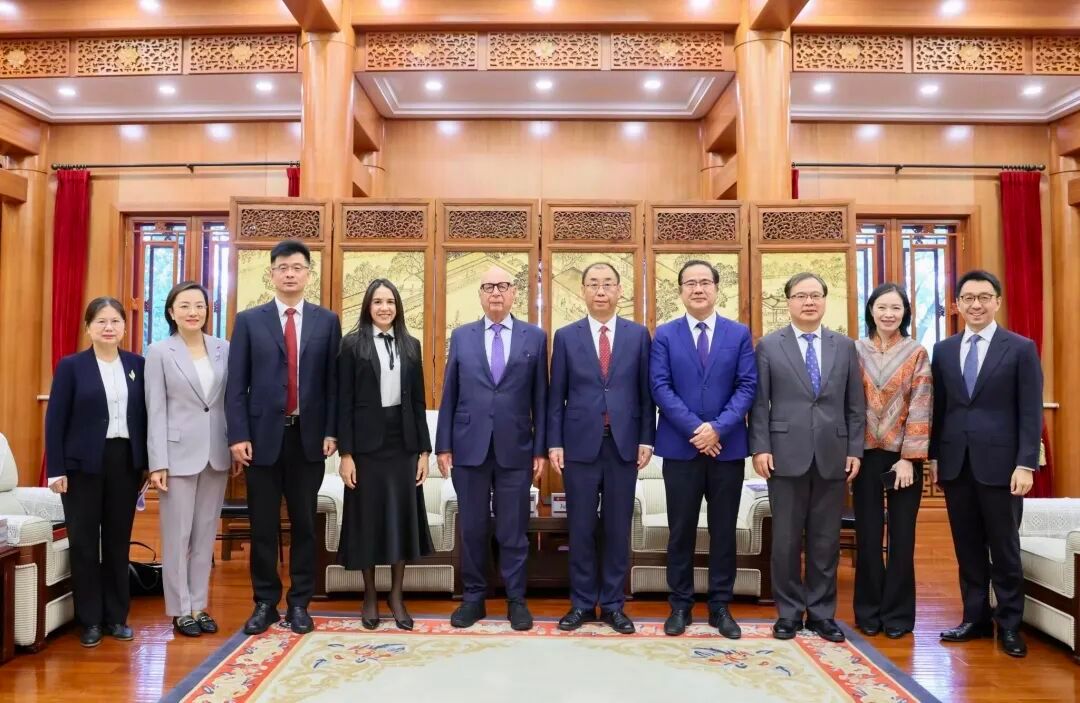
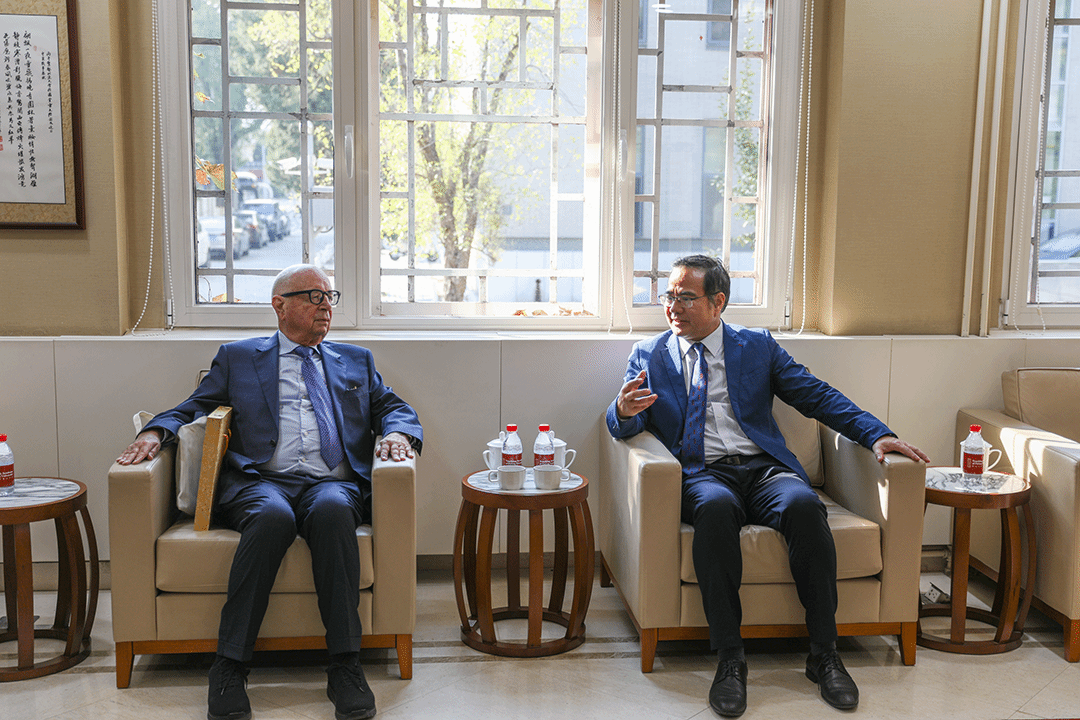
On October 22, World Economic Forum (WEF) founder and former Executive Chairman Klaus Schwab visited Peking University, meeting with Deputy University Council Chair and Provost Jiang Guohua at the Linhuxuan reception area. After that, Schwab paid a visit to Yenching Academy.
The Schwab delegation met with YCA Dean Dong Qiang, Associate Deans Fan Shiming and Brent Haas, and Assistant Dean Chen Changwei at Jingyuan Courtyard 3. The two sides discussed the development of young talent worldwide and social changes in the AI era.
Dean Dong Qiang first gave an overview of the Academy’s China Studies program, educational framework, and development and achievement over the past decade or so. Dong pointed that Yenching Academy is rooted in PKU’s deep tradition of the humanities and social sciences and is committed to building bridges between China and the rest of the world through its interdisciplinary, cross-cultural master’s program in China Studies. Spanning six tracks between literature, history, philosophy, politics, economics, and law, the master’s program accepts young talent around the world and aims to foster young leaders with a nuanced understanding of China, a willingness to connect with the world, and a capacity for global governance.
The two-year, fully-funded master’s program in China Studies offers life support and rich academic resources for its Chinese and international Scholars alike, in addition to holistically facilitating their development and growth. The Academy has placed equal emphasis on book knowledge and hands-on practice and experience, incorporating field study trips to cultural heritage sites and industrial parks across China into the curriculum, allowing Yenching Scholars to have personal observations and experience with a real, contemporary China. Yenching Academy adheres to a highly selective global admissions process with high standards and rigorous criteria. Its Scholars and alumni are from nearly 100 countries and regions all over the world. Many Yenching Academy graduates continue to pursue doctoral degrees at top-tier universities such as Oxford, Cambridge, and Princeton, acting as key players in academic exchanges between China and the rest of the world.
Dean Dong noted that Yenching Academy is committed to building itself into an international platform for high-level dialogues and invites former heads of government, eminent scholars, and leading professionals from all over the world to give regular lectures, bringing broader global perspectives to students. Dong gave special emphasis to YCA’s flagship event, the Yenching Global Symposium (YGS), and cordially invited Schwab to attend the annual event. He observed that many international political figures had little in-depth personal experience with China, which only allowed a fragmented understanding and perception of China through their short business visits to the country, which then in turn led to cultural estrangement and perceptual bias. Through its cross-cultural master’s program, Yenching Academy serves as an enduring force in dispelling misunderstandings across cultures and fostering mutual trust between Chinese and international young talents.
Schwab thought highly of the Academy’s vision and achievements, saying that the Academy holds distinct value and contributes greatly to global youth exchanges as well as cross-civilizational dialogue. He highlighted that in a new stage of globalization where the world landscape is undergoing profound changes, in-depth dialogues across different civilizations, countries and youth communities are the key to tackling the global governance dilemma and to forging global consensus.
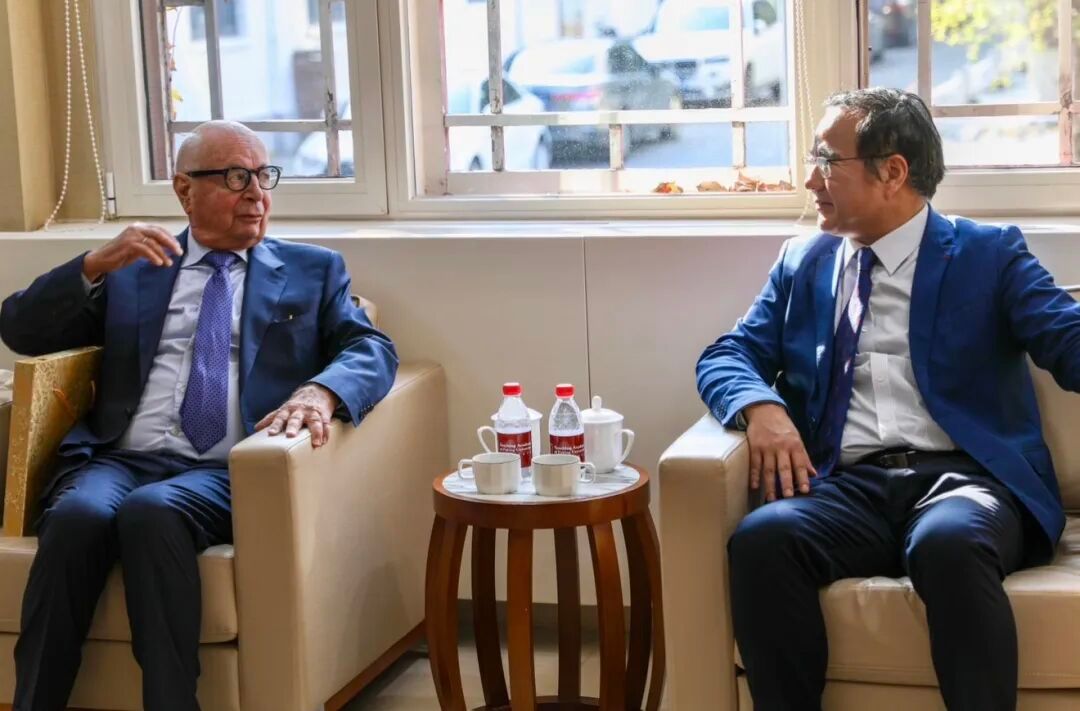
Both parties spoke on social changes and educational reform in the AI era. Schwab elaborated on the deeper meaning of the AI era, stressing that iterative advances in AI technology are far from the entire picture and that profound transformations are happening in the social structure, way of thinking, education system, and mode of global governance. He believed that technological advances must be defined by the boundaries of science, reason, and the humanities to ensure orderly, smooth, and sustainable social transformation. Schwab noted that universities in the new global context should not focus only on classroom teaching and academic research; rather, they must engage in decision-making in global business, politics, and public governance and leverage their strengths as intellectual hubs and value leaders. Dean Dong agreed with Schwab and warned against distorted perceptions of artificial intelligence in society. He pointed that artificial intelligence should not be deified as “superintelligence”, nor should technology override human wisdom. Techno-solutionism will severely undermine the core values of humanistic education, critical thinking, and human creativity.

After the meeting, Dean Dong Qiang accompanied Schwab and other visitors to the Second Gymnasium. YCA’s lecture hall in the Second Gymnasium draws inspiration from Louvre Museum’s glass pyramid for its design. The Pleyel piano lends added grace to this artistic-looking space, standing as perfect footnote to the Academy’s open and inclusive atmosphere.
Yang Yong, Deputy Director of the Department of European Affairs, Chinese People’s Institute of Foreign Affairs, and Rana Ammari, Senior Advisor to Mr. Schwab, accompanied Schwab in the visit.