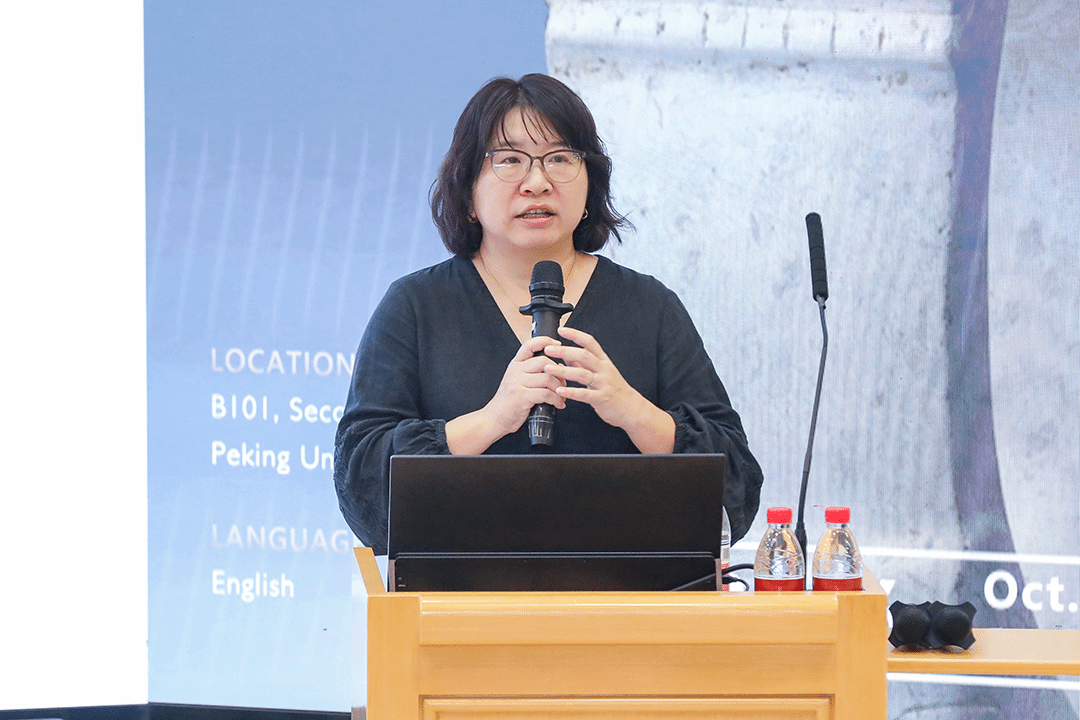
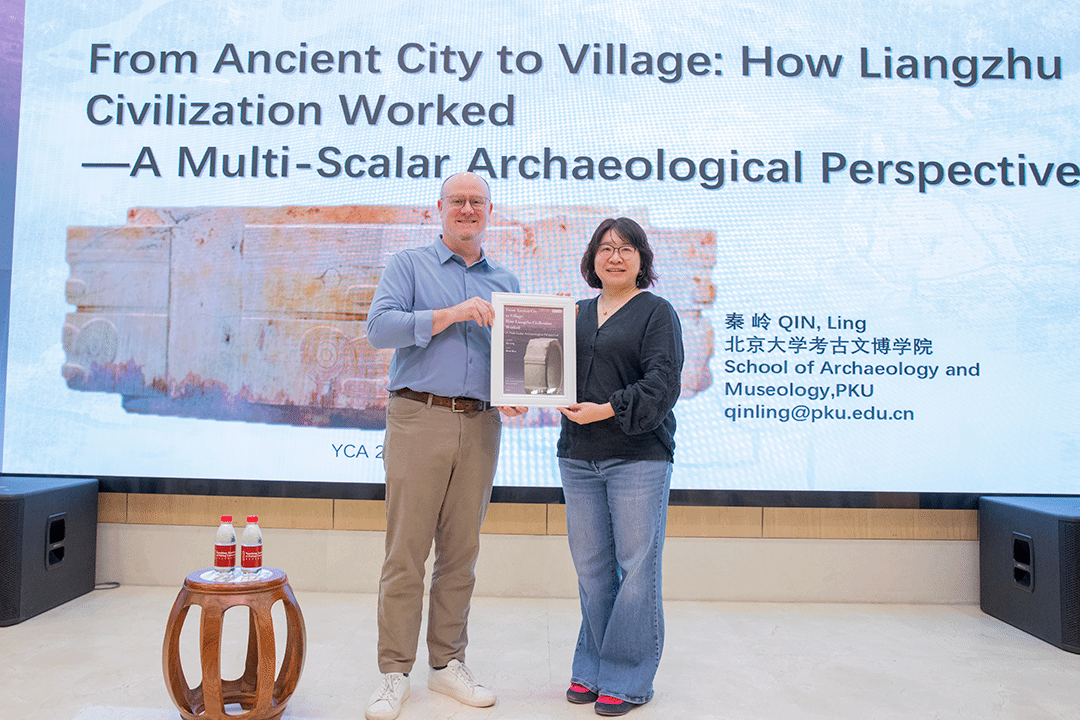
On October 14, Qin Ling, Associate Professor and Doctoral Supervisor at the School of Archaeology and Museology, Peking University, delivered a lecture titled “From Ancient City to Village: How Liangzhu Civilization Worked—A Multi-Scalar Archaeological Perspective.” This was the third lecture in the China Studies Lecture Series for the 2026‒2027 academic year and was hosted by Brent Haas, Associate Dean of Yenching Academy.
Interview Notes
Before the lecture, Associate Professor Qin Ling gave an interview. She first defined archaeology’s disciplinary positioning and its distinctive role. Archaeology falls under the humanities. At Peking University, the archaeology department is affiliated with the Faculty of Humanities because the goal of archaeology is to address social and historical issues— this disciplinary classification is determined by research orientation. However, the research approaches in archaeology are oriented toward natural sciences. Archaeology is thus an unconventional humanities discipline. It cannot be labeled as one or the other. Prof Qin used the term “compatibility” to describe the distinctive role of archaeology as a discipline. Research methods and approaches in archaeology are selected depending on the physical materials that have been discovered, to uncover the human and social mysteries behind the objects. The distinctive role of archaeology lies in tackling grand questions of humanity and society by examining tangible materials we have at hand. Archaeology integrates natural sciences and the humanities.
Associate Professor Qin Ling went on to characterize the relationship between theoretical concepts and the current understanding of the Liangzhu civilization. Prof. Qin noted that all concepts impose limits on human understanding. Language is an instrument of communication, while communication would be impossible without concepts. One can hardly conduct a comparative study without the knowledge of relevant concepts. However, The bounded nature of concepts helps precisely delineate the scope of research and the terms of comparison. Essentially, concepts themselves are meaningless in archaeology and must be grounded through material evidence. For instance, when we discuss “power” through the archaeological lens, analysis does not stop at the conceptual level; rather, archaeology explores who exercised power and for what purposes power was used—to control resources, technology, people, or systems of distribution. Concepts must be substantiated. “Society” is another example. A society can be a small village or a large civilization like Liangzhu—concepts like these are fluid and vary in scale. For Prof. Qin, concepts do not restrict understanding, but instead serve as a point of departure. Researchers can employ concepts to locate and grasp what the available materials can yield.
Associate Professor Qin Ling emphasized that rote learning must be avoided in archaeology or any other disciplines. One needs to understand, first of all, that our understanding of the past is neither absolutely right nor absolutely wrong. Knowledge should be received and accepted through critical analysis. Moreover, archaeology is the interplay between the macro and the micro. It can both address macro-level issues and examine micro-level materials like a single finger print on a pottery jar. This scale-shifting capacity facilitates learning and research in all disciplines; Prof. Qin expressed the hope that students could understand broader issues by examining small-scale materials. She highlighted again that concepts must be grounded in and substantiated through materials. It is especially true in an interdisciplinary, cross-cultural context, in which one concept generally has different meanings that may lead to misunderstanding. Before the interview came to an end, Prof. Qin Ling pointed that when we explore and try to understand the past, we do not rank them as early or late, good or bad, superior or inferior; we dig into the past to understand diversity and plurality of human societies.
Review of the Lecture
Associate Professor Qin Ling unrolled a cosmic calendar at the beginning of the lecture: If the entire history of the universe were compressed into one year, life would not emerge until November, and the human-ape divergence would occur on December 31, while civilization and forms of state would occupy the last ten seconds of the entire year. Accordingly, the professor marked the “three origins” relevant to the human society, namely the origins of modern humans, of agriculture, and of civilization and complex societies. Her lecture went on to focus on the third. Information on humans before the invention of writing is entirely derived from archaeological discoveries. Even after writing emerged, written records could not document everything throughout history. That’s why archaeology remains indispensable for revising established historical accounts. Archaeology enables a comparison of China and the West from their earliest origins.
The Liangzhu civilization offers a compelling case study. Dating to approximately 5,300‒4,500 years ago, the Liangzhu archaeological ruins, with the core area around Taihu Lake, is the first Neolithic site in East Asia inscribed on the World Heritage List. Associate Professor Qin first clarified the term “civilization” that is derived from the Latin word “civis” (which means “citizen”); therefore, “civilization” is not equivalent to the Chinese term wenming (文明), which stresses cultural refinement and moral virtue. In addition, the Liangzhu civilization had no writing system. Sima Qian was unaware of the existence of the Liangzhu civilization as he was working on Shiji. Additionally, Childe’s ten traits are not applicable in the Liangzhu case, as those criteria are a description of similarities across early civilizations, rather than a threshold. Prof. Qin elaborated on the issue from five dimensions, namely planning and scale, public works, degree of social stratification, scale of the agricultural economy, and specialized craft production.
The ancient city of Liangzhu was built on wetland, and all the building materials were transported by water. The length of the river within city limits measuerd 32 kilometers in total and was largely man-made. The ancient city was accessible through eight water gates and one land gate. The inner city occupied approximately 300 hectares, equivalent to the area of four Forbidden Cities. The artificially terrace on which the Mojiaoshan palace site was located rose 10 meters high from the ground. The volume of the earthenwork city wall and central terrace alone would require the manual labor of 10,000 people working year-round for seven years. Assuming that there were only 100 workable days per year during the rainy season, then the work would require 40,000 laborers working for 26 years. The high-dam system at the mouth of the valley outside the city served as a flood control measure, water supply, and transportation facility. Yet, no paddy field remains have been discovered around the ancient city.
The Liangzhu site had a hierarchy of cemeteries. The spatial layout, grave arrangement, and mortuary practices differ among elite and commoner tombs, presenting a pronounced social stratification in the Liangzhu society. The highest-ranking Fanshan cemetery contains only 11 tombs arranged in two rows, one row in the north and the other in the south. All the 11 tombs have yielded large quantities of fine jade. The spatial layout and the unearthed burial objects indicate that the top tier of society was buried in a cemetery separated from corporate lineage cemeteries. The jades are of extraordinary craftsmanship; one of the complete man-beast motif measures 3x4 cm, smaller than half of a student identification card. Despite its size, five or six discrete fine lines are incised within a span of 1 mm. Jades served as status and identity markers. Tapered pendants are found only in men’s tombs and typically arranged in odd numbers, with stone ones to fill the number if needed. There is only one jade yue (dagger-axe) in a tomb, and the other dagger-axes in the tomb, if any, are made of stone. The four-tier cemetery hierarchy in the ancient city is demonstrative of Liangzhu’s social stratification.
There was no rice farming in the ancient city of Liangzhu—thus, the existence of centralized grain storage is astounding. In the H11 pit on the east slope of Mojiaoshan, approximately 12,000kg of carbonized rice was discovered, while the carbonized rice remains in the Chizhongsi area in the south totaled approximately 20,000 kilograms. Strontium isotope analysis indicates that pigs at Liangzhu were largely transported from Haining, Shanghai, and other places farther away, rather than being locally raised. We can thereby conclude that the ruling elite and artisans did not engage in farming and were supported by a tributary system.
Jade artifacts stand as a testimony to the material and cultural sophistication of the Liangzhu society. Jade workshop sites were discovered inside and outside the ancient city; furthermore, grinding tools of different grades and flint engravers of various sizes were unearthed from the workshops near dams. Meanwhile at the Zhongjiagang area, large quantities of drill cores were discovered. Unfinished jade cong tubes and reworked pieces made from fragments of cong have been unearthed inside the city. Ruins of stone yue workshops were also found in addition to flint tool workshops. Complex as it was, jade production at Liangzhu was highly organized and specialized, with a clear division of labor from raw material cutting and drilling to decoration carving. The jade cong tube with the “man-beast” motif is a hallmark jade of Liangzhu. The stylized “man-beast” motif is seen in all types of Liangzhu jades as the symbol of the shared belief of the Liangzhu society.
Associate Professor Qin Ling then turned to the Yujiashan and Maoshan sites adjacent to Liangzhu. The six platforms surrounded by moats at the Yujiashan site are mutually separate. A total of 645 tombs have been discovered at the site, more than the total of tombs at the ancient city of Liangzhu. The headpiece ensemble discovered at the Yujiashan site is the same as that from the Fanshan royal tomb, but is made of different jade. The comparative study of the two headpiece ensembles indicates that different communities had their own raw materials, resources, and artisans, but shared one and same belief system. The Maoshan site reveals more about the agricultural landscape of Liangzhu; the paddy field discovered at the Maoshan site measures 30 meters wide and 18 meters long, divided by 14 or more field ridges. The layout is basically the same as any paddy field we see today. The Maoshan site is now covered with flood deposits—geochemical evidence indicates that the sediments were delivered by seawater intrusion caused by rising sea levels and storm surges, rather than being transported by mountain torrents.

At the end of her lecture, Prof. Qin Ling noted that the Liangzhu civilization was sustained by an extremely high rice productivity. The Near Eastern civilizations of a similar era lived on wheat, barley, and cattle and sheep; the Central Plains civilizations in China relied on bumper harvests of grain and thriving livestock; and the Neolithic communities in the lower Yangtze region rested solely on rice, building the only complex society on a single-crop agricultural economy in the Old World. The ancient city of Liangzhu was not the only center of the Circum-Taihu Lake Area. The one and same “man-beast” motif is widely seen on jades, ivory artifacts, lacquerware, and ceramics, as the shared knowledge among local communities in the region. Prof. Qin offered three approaches to studying a non-literate civilization like Liangzhu, namely gaining the panoramic view of a culture/civilization, examining the communities from within, and comparing the communities with one another. One can see the complete landscape of a civilization only when looking beyond single objects.
Q&A Session
Q: Is the flood the only explanation to the collapse of the Liangzhu civilization? To what extent does archaeology care about how a civilization ended, rather than how it lived and developed?
A: First of all, we must be aware of the time interval between the flood and the collapse of the Liangzhu civilization. The Liangzhu civilization collapsed around 4,500 years ago, while the large-scale flood deposit occurred approximately 4,000 years ago. The remains dating to the centuries in between are named Qianshanyang and Guangfulin archaeological cultures. Jade of Liangzhu disappeared before all the others, around 4,500 years ago. As large-scale production of jade artifacts no longer existed, the jade-based social hierarchy collapsed. Jade production is dependent on mineral sources, so no one knew how long the jade mining would last. Jade quality in the late Liangzhu civilization deteriorated significantly. Thus, the jade-based social hierarchy became untenable when the resource of jade was exhausted. There were still residents living in the ancient city of Liangzhu after the decline of jade production, and ceramics underwent some changes. However, without jade, we can hardly describe the social form and belief system at Liangzhu back at the time. Climate change was an underlying cause of the collapse. Palaeoenviromental evidence such as pollen indicates an increasing number of storms and minor and moderate floods. Although people were living on platforms and might not be afraid of floods, the problem was rice farming: rice farming requires water, but rice is susceptible to waterlogging. When waterlogged, rice plants produce only leaves and no flowers. The hydraulic works in the region functioned less as an irrigation system than as a drainage system. As a result, the local population kept shrinking and we do not know where they finally migrated.
Q: You participated in the exhibition design of the Yujiashan Site Museum. Could you please give us some suggestions on how to make the most of a museum visit?
A: My suggestion is to choose an exhibition narrative and follow it. One narrative explores “what happened here 5,000 years ago”—what the Maoshan and Yujiashan sites look like and what the tombs look like; this storyline illustrates the past of the place. The other narrative line describes “how archaeology interprets the available materials”—the samples for radiocarbon dating and the methods for jade analysis, plus additional information such as elementary analysis results in the lower drawers of the display cabinets. I would advise not switching back and forth between the two narratives. Choose one and follow it to the end for a fuller visitor experience.