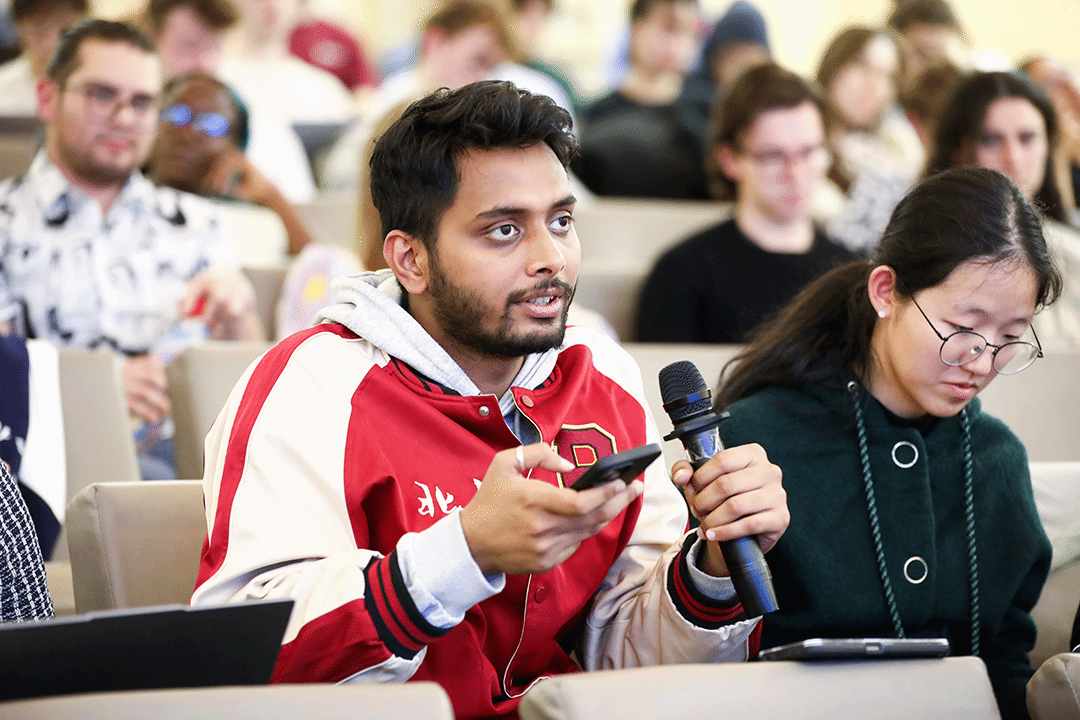
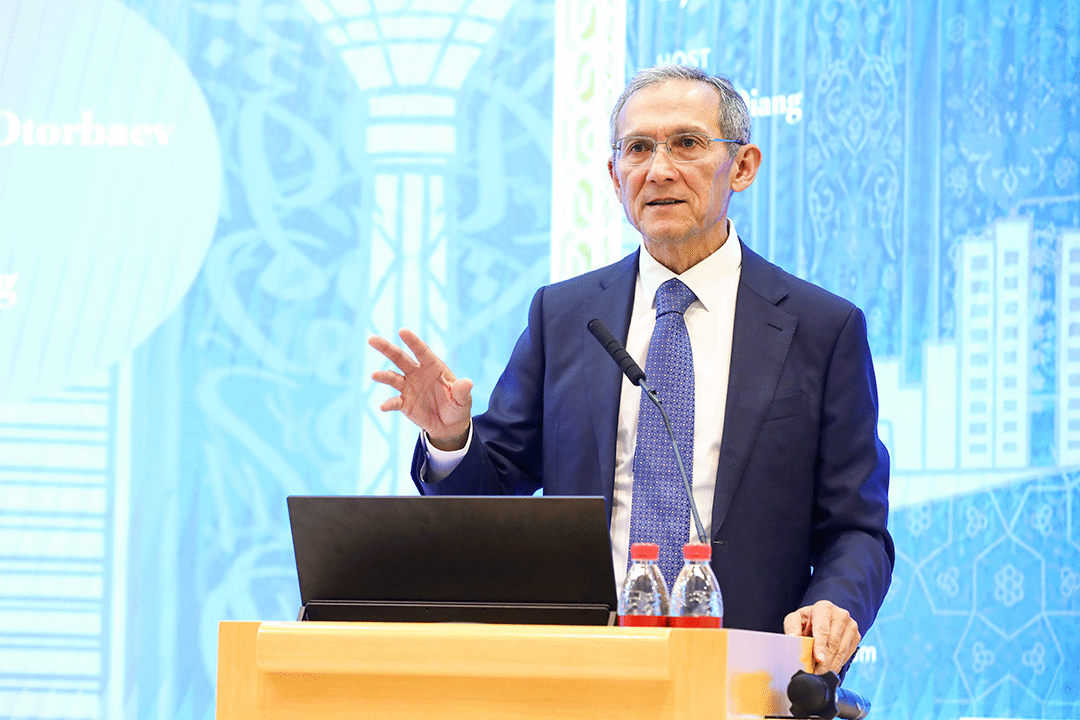
On October 21, Djoomart Otorbaev, Former Prime Minister of Kyrgyzstan, delivered a lecture titled “The Transformation of Central Asia: The Next Asian Tiger in the Making and Its Implications for China” at the invitation of Dong Qiang, Dean of Yenching Academy. This was the fourth lecture in the China Studies Lecture Series for the 2026‒2027 academic year and was hosted by Dean Dong Qiang.

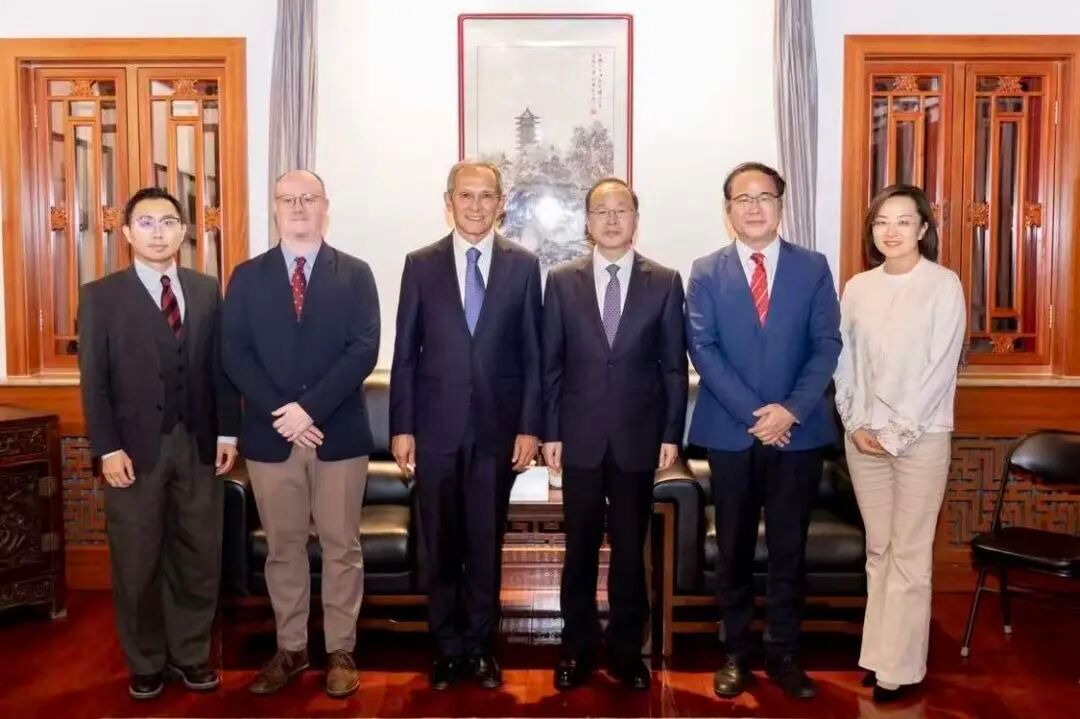
Before giving the lecture at YCA, Otorbaev met with He Guangcai, Chair of the Peking University Council, at the Linhuxuan reception area. China and Kyrgyzstan enjoy a long-standing friendship. In the joint declaration, the two heads of state stress that the two sides will steadily promote cooperation in various fields, such as education, young talent training, and scientific research, and join hands to build a China-Kyrgyzstan community with a shared future. He Guangcai expressed the hope that Peking University and Kyrgyz universities could strengthen exchange and collaboration in talent development and academic research. Otorbaev said that Peking University is highly regarded in academic circles around the world. He would like to use this visit as an opportunity to encourage more Kyrgyz universities to establish contact and conduct exchanges with Peking University, working together to address the new challenges and promote the peaceful development of the region.
Interview Notes
Before the lecture, Djoomart Otorbaev gave an interview. He first emphasized that Central Asia’s rise as the next Asian Tiger. Over the past 20 years, the annual economic growth in Central Asia has been over 6.7%. In addition, Central Asian countries see a positive demographic development. He noted that the education level of young people in Central Asia is high, which is a legacy from the former Soviet Union. Every year, two million digitally literate young and active people enter the labor market, providing driving force for the future of the region. However, the total population of Central Asia is only approximately 85 million people, and the regional market is limited. As such, Central Asia expects intensive high-quality collaboration with China. Otorbaev stressed that China is a leading country in the fields of technology, digital economy, and artificial intelligence, and more importantly, a neighbor to Central Asia. Central Asia regards China as a technological and economic partner, rather than purely a product market.
Otorbaev pointed that high transport costs are a major problem for inland countries. In history, Central Asia was one of the most prosperous regions in the world, thanks to the thriving overland trade along the ancient Silk Road. Now at the beginning of the New Silk Road, Central Asia benefits from the efficient China-Europe Railway Express. Three railways run through Kyrgyzstan, connecting China and Europe. The upcoming China-Kyrgyzstan-Uzbekistan Railway will be the shortest route between China and Europe, and the Chongqing-Duisburg route will take only nine days, faster than transporting goods by sea. Otorbaev quoted the Chinese saying, “if one wants to get rich, build roads first”, observing that thanks to the roads and railways, Central Asia will be transformed from “land-locked” into “land-connected” and have access to both Chinese and European markets with lowered transport costs. More importantly, connectivity is more than the trade of goods; it promotes people-to-people exchanges. With these routes, Central Asia will again become the hub where the East meets the West and where scholars and talents are brought together across the Eurasian Continent.
Otorbaev is himself an example of interdisciplinary experience spanning physics, economics, and politics. He was impressed by the competency of Yenching Scholars, because they have succeeded in a highly selective process. Otorbaev emphasized that education quality is not determined by teachers alone; rather, communication among students in a highly talented group is equally important. He believed that Yenching Scholars, who have succeeded with their hard work and competitive qualities, will become high-level talent after two years at Yenching Academy. Otorbaev observed that China and the West are two different worlds, and that students choose to study at Yenching with an aspiration of becoming the bridges between different civilizations. With this experience, they will obtain a high-level understanding of the modern world in the interactions between different civilizations. He believed that Yenching graduates will be the leaders of civilization in the 21st century.
Review of the Lecture
Otorbaev started his lecture with the transformation of Central Asian countries after the collapse of the Soviet Union in 1991. At the time, it was imperative for these newly independent states in Central Asia to build their own economic systems and define their position in Eurasia. Over the past three decades or so, a new stage of development has been ushered in for Central Asia, resulting in rapid economic growth, a sustained inflow of young people into the labor market, a thriving digital economy, and vibrant entrepreneurial activity. Such changes are underpinned by not only the resource endowment of Central Asia, but also an educational foundation of the former Soviet Union and local families’ long-standing commitment to education. This lecture was thus focused on a core question: Will Central Asia become the next “Asian Tiger” and in what way can Central Asia and China engage in more sustained cooperation?
After the collapse of the Soviet Union in 1991, Central Asian countries began to independently explore their own development paths. The economic and institutional transition was hard, but the Soviet-era education system has survived in many of these countries. Many families are willing to spend on their children’s education, despite limited income. Otorbaev regarded education as an advantage Central Asia enjoys today. The region has seen a rapid economic growth over the years with a relatively young population. Geographically closer to Europe, Central Asia has a total population of approximately 85 million. Every year, large numbers of young people enter the labor market. More people are engaging in trade, digital services, and entrepreneurial activity—Otorbaev observed that such developments create the conditions for Central Asia to emerge as the next “Asian Tiger.” However, growth figures alone do not mean a true transition, and a true transition hinges more on industrial transformation and local employment opportunities for young people.

Early cooperation between China and Central Asia concentrated in the fields of petroleum, natural gas, and metals. With the strengthening economic and trade ties between the two sides, Central Asian countries increasingly hope that Chinese investment would boost local manufacturing, technological transfer, and employment, rather than treating them only as a source of raw materials. In comparison, Otorbaev observed that Chinese leaders have identified digital economy, green energy, and artificial intelligence as the top three areas for future cooperation. He stressed that in their project negotiation with Chinese enterprises, Central Asian countries must clarify their needs; delineate unacceptable terms; and specify requirements for environmental protection, local employment, and supporting industries. Sustained cooperation depends on not only the investment size, but also a project’s alignment with local development needs.
As a landlocked region, Central Asia has been constrained greatly in international trade. Without access to sea freight that costs less than overland transport, Central Asian enterprises must pay more for overland transport of goods to European, East Asian or South Asian markets. However, Central Asia is greatly benefited by the expansion of the China-Europe Railway Express, the China-Kyrgyzstan-Uzbekistan Railway under construction, and the continuously improving regional highway network. Otorbaev noted that Central Asia is transforming from a landlocked region into a land-linked one. In the past, Central Asia faced constraints by its landlocked geography, which now enables the region to serve as a transport hub connecting China, Europe, West Asia, and South Asia. Rail transport is ideal for high-value, time-sensitive goods, such as electronic products and semiconductors. Despite this, the countries involved also need to simplify the customs and border procedures and reduce the cost of Trans-Caspian transport to substantially improve the efficiency of overland routes.
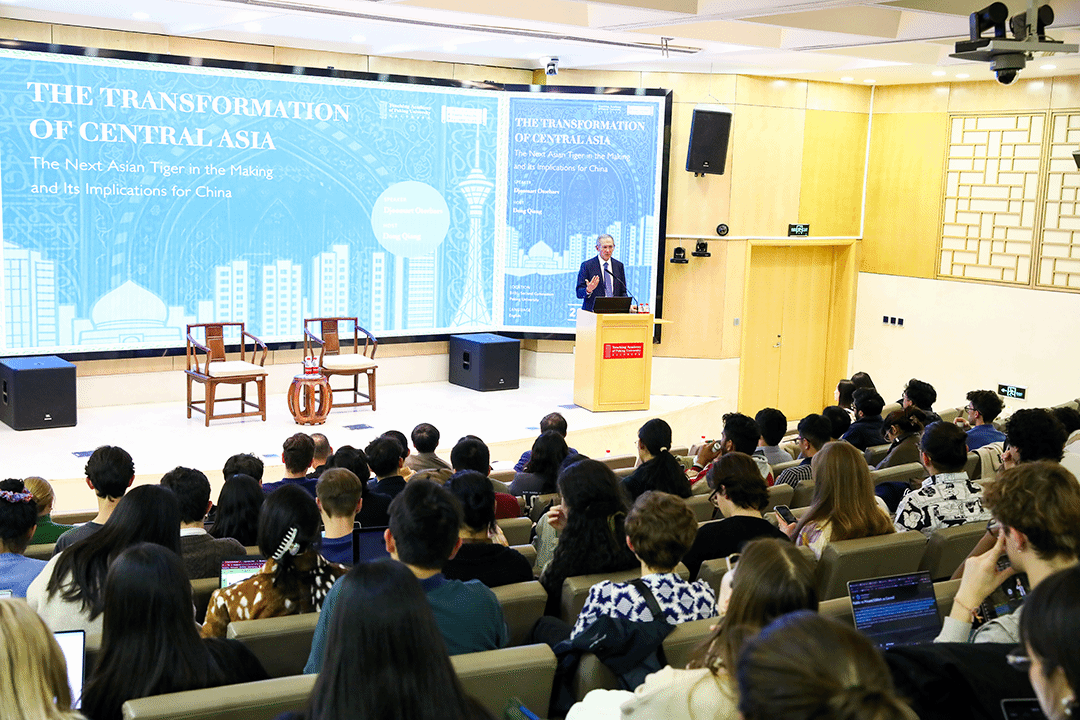
Otorbaev regarded the commitment to education and STEM talent training as the underlying factor behind China’s scientific and technological advancement. He also observed that there is room for improvement in China’s basic science and original research and that more efforts are expected to create a more supportive working environment for international scientific research talent in China. He pointed that AI competition occurs not only at the model and algorithm level, but that data centers, power supply, and grid infrastructure are equally important. Innovation centers in Beijing, Shenzhen, and Hangzhou focus on different aspects, while data infrastructure is under construction in the western and northern areas of China. For the international students present at the lecture, Otorbaev hoped that they learn the Chinese language, understand Chinese society, and work together with their fellow Chinese students, because one can understand what China is like only by learning Chinese language and living in Chinese society.
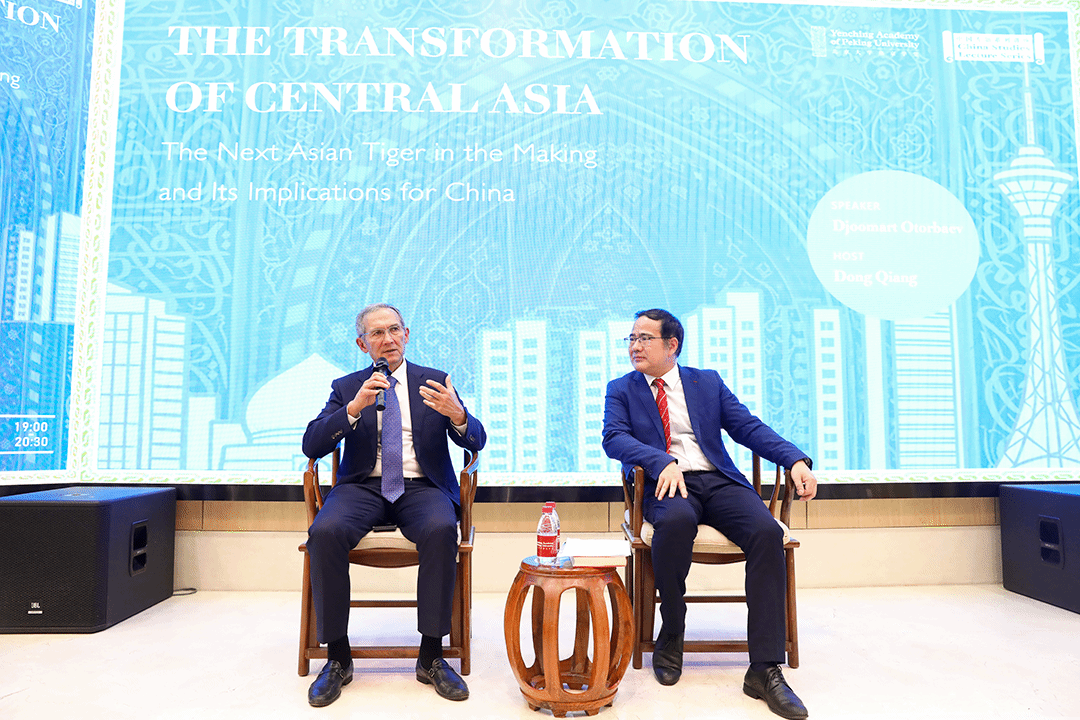
Lu Yang, Director of Graduate Studies of Yenching Academy, reviewed the lecture from a historical perspective: Sogdian merchants were active players in the ancient Eurasian trade network, engaging in cross-regional trade and bringing along different religions, music, dances, and ideas. Sogdians were good negotiators who well adapted themselves to diverse cultures, which is why they could retain room to maneuver between major powers. The history reveals that Central Asia was not always the passive party in great-power competition. Central Asian countries can definitely play an active role in Eurasia so long as they keep in contact within the region and establish mutual trust with neighboring countries.
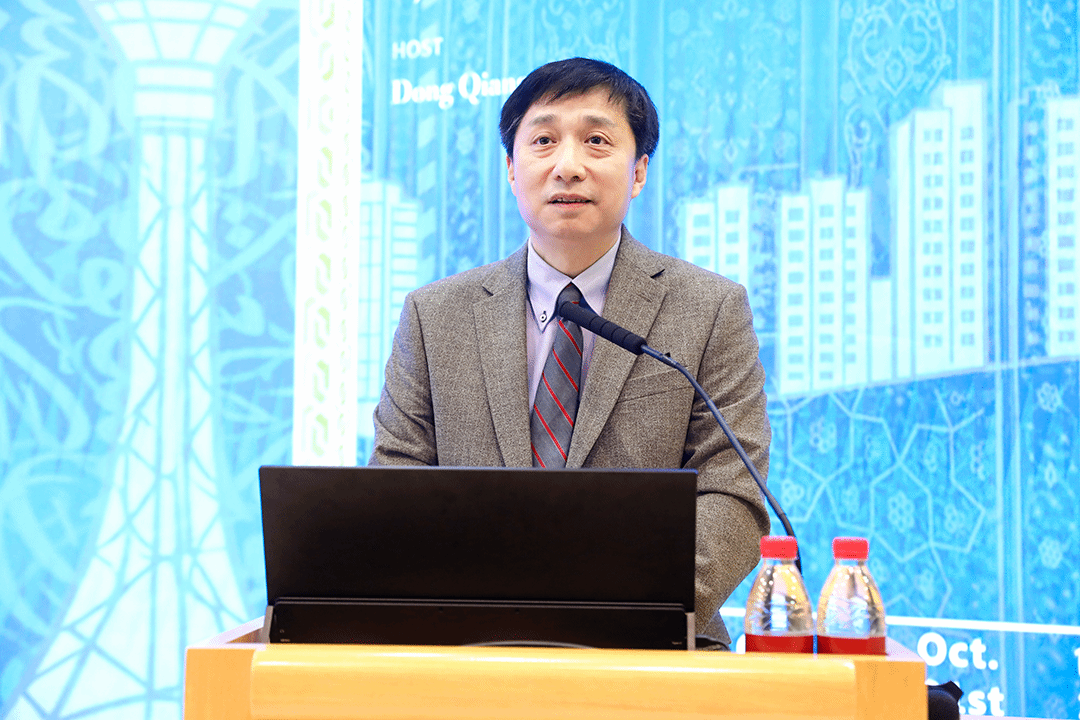
At the end of the lecture, Dean Dong Qiang revisited the friendship between Otorbaev and YCA and his care for the Academy’s development. Otorbaev delivered the keynote speech at last year’s YGS and joined the student delegates during the event. This June in Uzbekistan, Otorbaev and Dong Qiang had an in-depth discussion on the relations between China and Central Asia. The two recommended The Day Lasts More Than a Hundred Years written by Chingiz Aytmatov, a Kyrgyz author, hoping that students can have a deeper understanding of the history, steppe life and social changes in Central Asia through literary works.

Q&A Session
Q: If Central Asia is geographically at the center of Eurasia, why has it been marginalized for so long?
A: First of all, I think it’s because of the inland geographic constraints. Sea freight is cheaper than overland transport in the long run. Thus, Central Asian enterprises pay more for the transport of goods to international markets. Also, the Central Asian population is small compared to the expanse of the region. But things are changing. Rail transport is getting faster between China and Europe, enabling Central Asia to turn from being landlocked to being land-linked. However, improved transport doesn’t mean that all problems will resolve themselves. We have many other issues to address, such as glacier retreat and declining water resources. They have affected our agricultural and urban development.
Q: What can a medium-sized country do to promote peace in the context of great-power competition?
A: For an inland country, it is not an option but a precondition to maintain stable relations with its neighboring countries. Landlocked countries cannot bypass their neighbors when reaching global markets, so we must learn to cooperate. The five Central Asian countries have conducted dialogues with China, the United States, the European Union, Japan, and South Korea under the “C5+1” framework. An individual of the five Central Asian countries does not make great impact, but together we can have our voices heard by the international community. I think, small- and medium-sized countries have other options than to take sides in great-power competition. They can strengthen their voices through regional cooperation and have communication and coordination among different sides.
Q: Is rail transport safer than sea transport in face of geopolitical risks?
A: Rail transport is also affected by political situations. I don’t think overland transport can be totally spared from geopolitical risks. Some European customers are worried about the railway lines running through Russia, and the Middle Corridor that connects China, Central Asia, the Caspian Sea, the Caucasus, and Turkey attracting more attention. Trans-Caspian transport costs more, and the countries involved need to further streamline their customs and border procedures. Overland transport is ideal for high-value, time-sensitive goods, such as electronic products and semiconductors. What we need to do is to create more route options, not replace one with another.