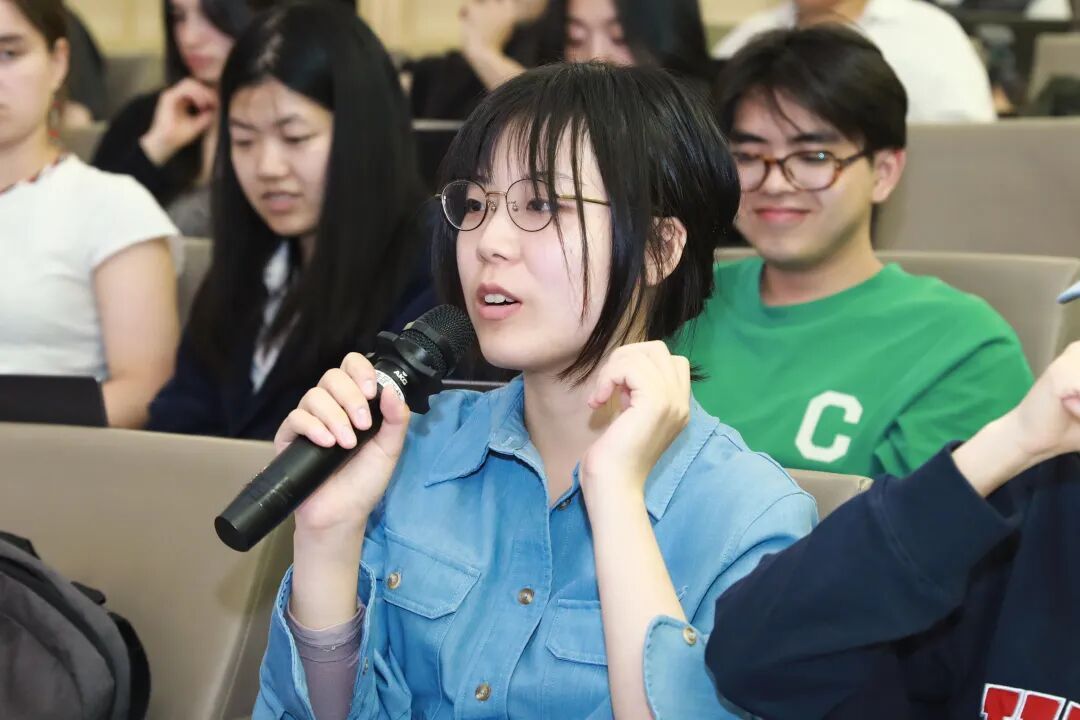
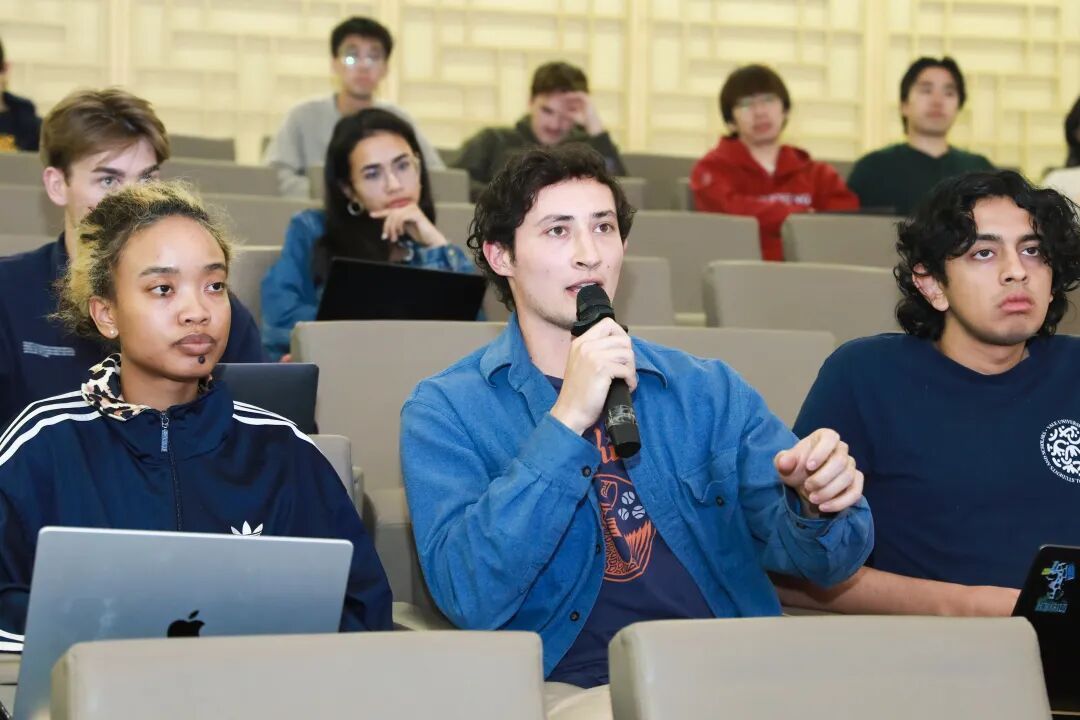
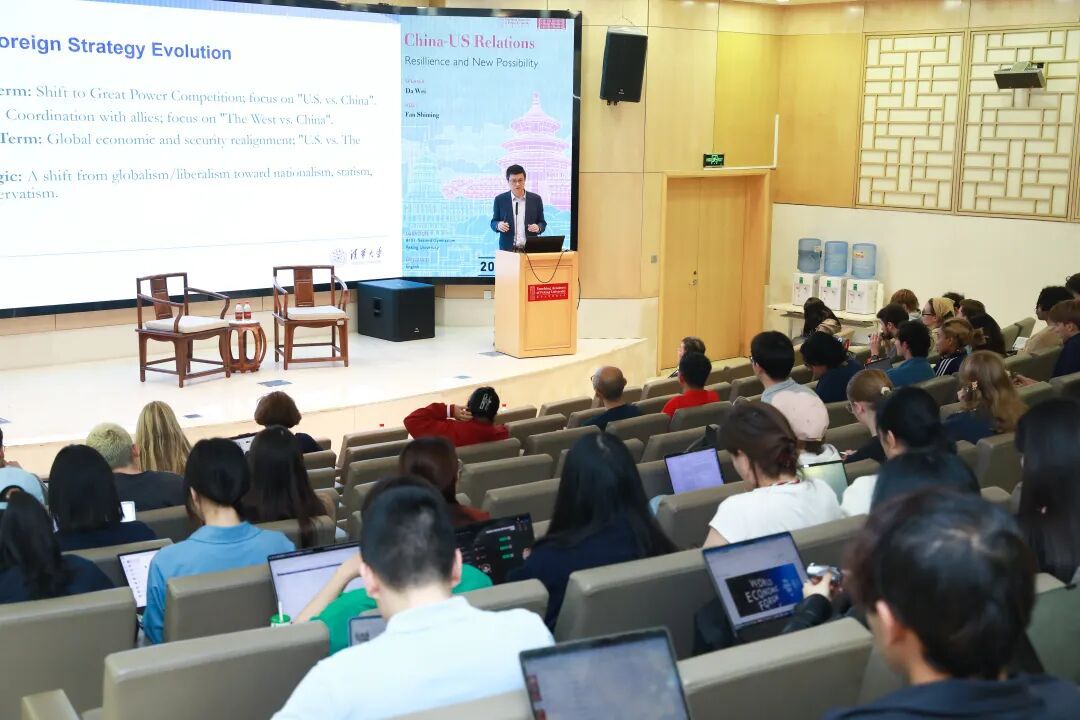
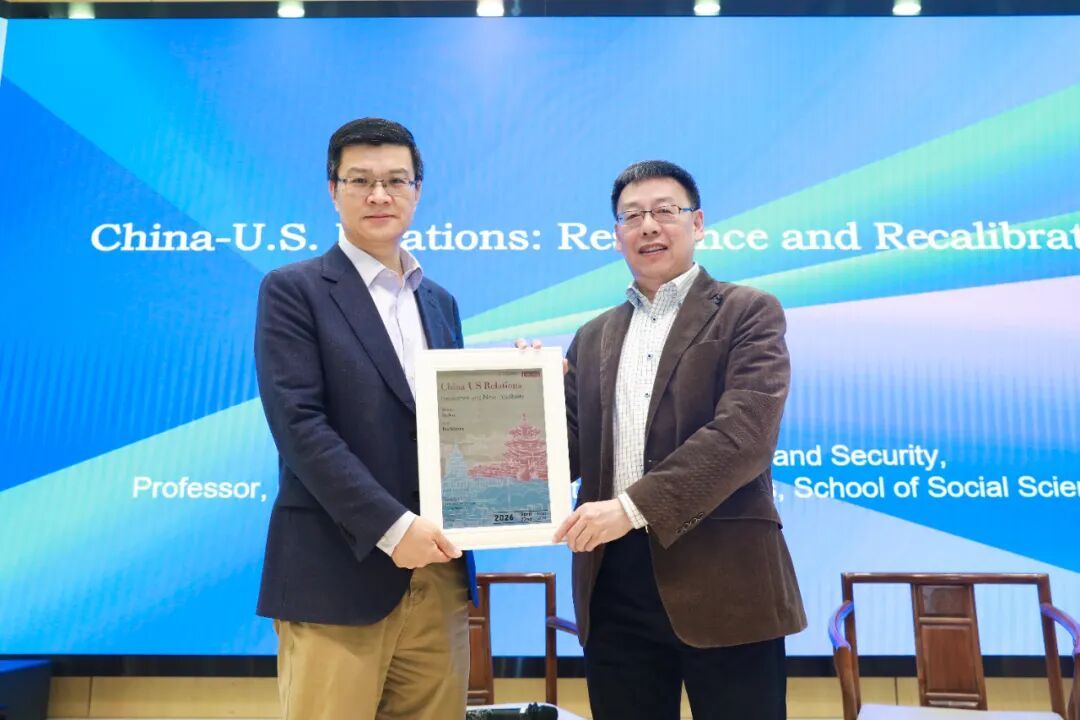
On April 22, Da Wei, Director of the Centre for Strategy and Security and concurrently professor in the Department of International Relations, School of Social Sciences at Tsinghua University, delivered a lecture titled “China-US Relations: Resilience and New Possibility” at the Yenching Academy. This was the 11th lecture in the China Studies Lecture Series for the 2025‒2026 academic year and was hosted by YCA Associate Dean Fan Shiming.
Interview Notes
Before the lecture, Professor Da Wei gave an interview. Prof Da first introduced “mutual assured disruption”, a concept describing the current China-US relations. The concept is borrowed from the military version “mutual assured destruction”, a nuclear deterrence strategy that deters two nuclear-armed adversaries from initiating a nuclear attack for fear of full retaliation and destruction of both. The logic has now been applied to scenarios outside the military, like economic warfare. Over the past seven or eight years, the US has kept disrupting China’s supply chain in a “cutthroat” manner. However, China launched effective “counterattacks” on the US in 2025, including export controls on rare earths and other critical minerals. The two countries have effectively entered a state of “mutual assured disruption”. According to Professor Da, securitisation and weaponisation of China-US economic ties is by no means an ideal state; yet, the mutual checking effectively deters either from resorting to unilateral maximum pressure and facilitates a degradation of economic confrontations, leading China-US relations towards a relative stability in the coming years.
Professor Da Wei turned to the questions on policy research and academic research. In his opinion, there are no substantive differences in the underlying logic of the two, because both must be accurate about concept and relevant to real-world issues. Academic research provides the intellectual underpinning and analytical framework for policy research, so that policy research is not fully guided or even misguided by the availability of information. In turn, policy context empowers theoretical research with more practical relevance. Policy research and academic research are mutually complementary and reinforcing. Yet, approaches differ. Policy research requires staying half a step ahead of practice. It is backed by face-to-face dialogues with people, from government officials to business leaders, to keep updated with the latest developments and produce timely articles. In contrast, academic research involves more desk work and is time-consuming. For an academic topic, years of research and thinking may culminate in a single article or book, but topicality is not too important.
Prof Da Wei laid special emphasis on technological background and humanities literacy, which may prepare Yenching Scholars for their specialised training and future careers. The professor noted that technology is radically transforming our times and international relations, and that in an AI era, international affairs professionals must be competent in both STEM and the arts. International relations are traditionally regarded as a discipline of the humanities, but IR professionals today need to equip themselves with STEM knowledge and technology-enhanced research and practical skills. The profession places an equal emphasis on humanities literacy. Engagement with international affairs requires strong empathy. An international affair professional needs to agree to disagree—an ability to understand perspectives different from their own. This is an ability that could be shaped by long-time humanities training, from reading literary works to engaging with the arts.
Review of the Lecture
The lecture was given at an opportune time, when China-US relations are undergoing a historical change. Prof Da Wei examined the ups and downs in China-US relations in the past eight years and dissected the structural changes in both China and the US, before exploring the paths to and the landscape of rebalancing the relations between the two nations.
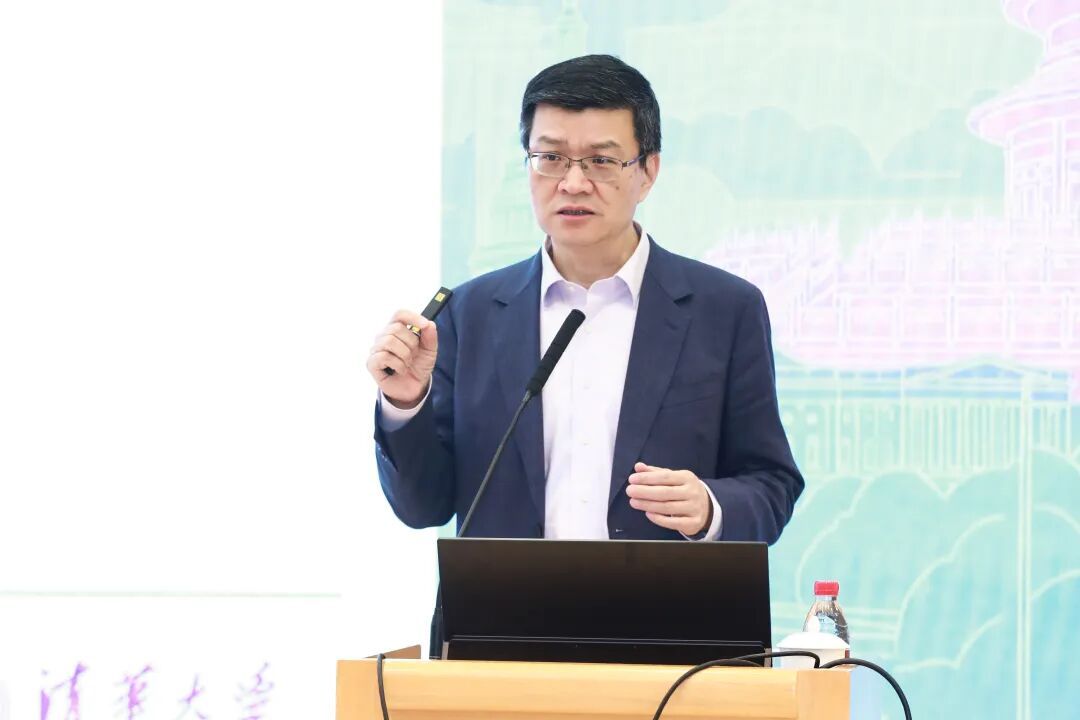
Based on his observations, Prof Da Wei noted that developments in China-US relations over the past eight years were characterised by “five shocks”. The Section 301 tariff war waged by the US in March 2018 marked the first shock. The second hit in 2020 came when the COVID-19 pandemic and the Trump administration’s adversarial China policy dragged China-US relations to a historic low since President Nixon’s visit to China in 1972. The February 2023 balloon incident, politicised by Washington, fermented into a diplomatic crisis and dealt a third shock to the bilateral relationship. The remaining two major shocks both struck in 2025. In April, the Trump administration’s “Liberty Day” tariffs pushed bilateral tariff rates to record highs of 145% on US imports from China and 125% on Chinese imports from the US. The US entity control expansion in September of that year triggered a new round of confrontation. Nonetheless, China-US relations returned to stability after every shock. Professor Da observed the underlying structural logic that both Beijing and Washington have signalled willingness to stabilise China-US relations—whether the White House is held by the Republicans or the Democrats. It is by no means incidental. The willingness to pursue a stable bilateral relationship is a structural demand of both nations. And every return to stability epitomises a new normal of resilience in China-US relations.
Professor Da proposed a thought-provoking analytical framework for the US foreign strategy evolution. The underlying theme of US foreign policy during Trump’s first term of office was “US vs. China”, the adversarial tone of which continued into the Biden administration, only that the US resorted to a multilateral coalition to keep China out of global supply chains, shielding a “West vs. China” pattern. Trump’s second-term foreign strategy rejected liberal internationalism and accelerated toward a conservative nationalist approach, and the underlying theme was shifted from “US vs. China” to “US vs. the world” In Trump’s second term, “the adults in the room”—the establishment figures within Trump’s first-term administration who were regarded as “the brake” on Trump’s dashing to conservative nationalism—were fired, resigned or sidelined. With “the adults in the room” chased out, the second Trump administration operates with a more centralised decision-making style, characterised by personal loyalty to the president.
Professor Da also noted that developments in China-US relations in recent years are under the impact of the shift of China’s strategic mentality. China has braved the ever-challenging trade wars, seizing the initiative in its relationship with the United States, particularly in the three distinct moments in 2025. The “DeepSeek moment” shocked the AI landscape and was prismatic of the resilience of the lifeblood of China’s economy and indigenous innovation. Then, China took resolute, strategic counterstrike in April and May, making Trump’s “TACO moment” bluffing tactics ineffective. The “rare-earth moment” inaugurated a deterrent balance of “mutual assured disruption” in the economic sector. By strategically leveraging its dominance in rare earth refining, China effectively counterbalanced the US attempt to strangle semiconductor imports to China. The fragile yet long-lasting economic interdependence has thus been retained.
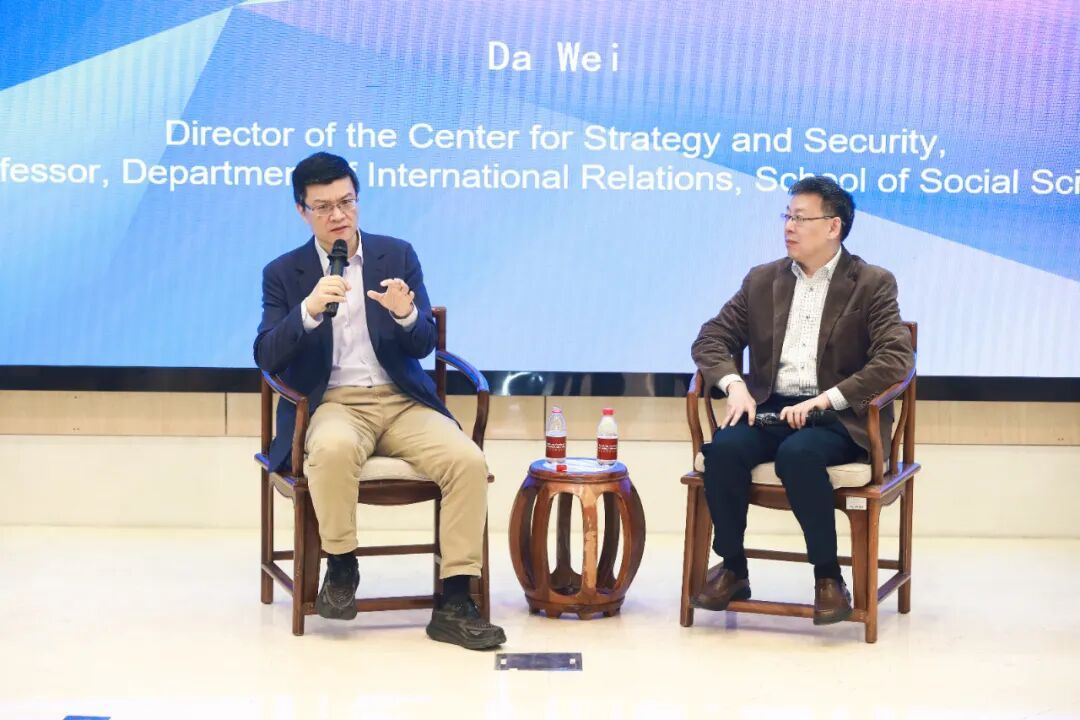
Professor Da Wei offered penetrating insight into the turning point of China-US relations: The bilateral relationship is undergoing a profound historic restructuring, and the stances and strategies of both sides are inextricably linked to the landscape of the international order. It is imperative to rebalance China-US relations. First, the two sides need to restore economic interdependence, establishing clear and predictable boundaries for cooperation. A new geostrategic equilibrium needs to be forged, reducing the risk of conflicts in sensitive zones, such as the Taiwan Strait and South China Sea and constructing a Western Pacific coexistence framework adapted to a rising China. Finally, the summit-level stewardship must be in place. Through face-to-face meetings of top leaders, mutual political trust shall be cemented, laying a foundation for a sustainable and stable bilateral relationship.
Q&A Session
Q: Which is more important, systemic resilience or interactions between decision-makers? And how long will the current stability last?
A: For your first question, both are important, but on different analytical levels. Systemic factors constitute the baseline stability, so that full decoupling and hot war remain as low-probability events even if the Chinese and US presidents don’t have frequent meetings. However, top leaders do decide the depth and quality of the stability. Therefore, I hope to see more substantive breakthroughs made in a period of intensive summitry, instead of mere avoidance of the worst.
Q: What does the China-US rivalry mean for middle powers, such as Canada?
A: Prime Minister Carney’s call for a coalition of middle powers is to the point, only that it needs to be accommodated in the real-world landscape. Middle powers must find the best point between China and the United States that serves their own interests, whilst avoiding the trap of aligning exclusively with one side. What’s more important is that middle powers cannot rely solely on a Democratic restoration of the liberal international order. The United States is undergoing systemic changes, and middle powers must forge a genuine independent strength and purpose of their own.