From November 16 to November 22, 2025, the 11th cohort Yenching Scholars took part in an in-depth exploration through Zhejiang Province, being immersed in the regions historical, cultural, and technological realms. As a core requirement course, the Yenching Academy field trip combines a wide mix of experiences, including engaging visits to significant sites, and hands-on cultural activities, all crafted to broaden the Scholars appreciation of China’s longstanding traditions and its rapidly evolving modern landscape.
This report outlines the journey of the week, capturing both the educational and cultural highlights as well as the memorable moments that left a lasting impression on all participants.
(Day 1) Blending Tradition and Creativity: Hangzhou Welcomes YCA Scholars
The field trip began with a talk by Professor Lu Yang at Reading West Lake, where he introduced Scholars to the history of Mahāyāna Buddhism, its development in China, and Hangzhou’s role in shaping these traditions across Asia. After the lecture, the group took part in an opening ceremony that officially welcomed them to their new base in the city. The Deputy Director of the Publicity Department of Xihu District, Wei Jun, offered the first greetings, setting the tone for the week ahead.

The ceremony continued with remarks from YCA Associate Dean, Brent Haas, followed by local Hangzhou resident and YCA Dean Dong Qiang, who spoke about the city’s cultural significance and its distinctive humanities tradition. Next, the unveiling ceremony of the "Hangzhou International Talent Exchange Practice Base" co-established by Yenching Academy and Xiaofeng Bookstore was held.


Then, Professor of Chinese Linguistics and Deputy Director of the Institute of China Studies in Zhejiang University, Li Xuping then shared an engaging introduction to Yue opera and its deep roots in Hangzhou. The event came to life with a cultural program that blended local heritage and student creativity: a performance of Yue opera alongside an abridged Romeo and Juliet presented by YCA Scholars. This warm and lively welcome offered the Scholars an inspiring start to their week in Hangzhou.

(Day 2) Exploring ancient civilisations: Liangzhu culture and Wuyue Heritage
The day of history began with a visit to the Liangzhu Museum, renowned for preserving the civilisation, culture, and historical landscapes of the Liangzhu period. Scholars gained a deeper understanding of traditional Chinese philosophy as reflected in the land itself, as well as the cultural and ritual significance of jade in Liangzhu society.

Following the museum, the group explored the Liangzhu Ancient City Relic Park, where they were able to connect the knowledge gained at the museum with the physical landscape. With “Liangzhu” meaning “beautiful land surrounded by water,” Scholars observed the way the civilisation aligned its surroundings with its cultural values.

In the afternoon, Scholars visited the Lin’an Museum, which highlights the historical roots of Wuyue culture and showcases artifacts related to Qian Liu, the founder of the Wuyue Kingdom, including examples of his calligraphy. Through over 4,000 displayed items, Scholars were able to explore the daily life, material culture, and design structures of the period, gaining a richer appreciation of both historical and cultural context.

(Day 3) Immersed in History at Lingyin Temple
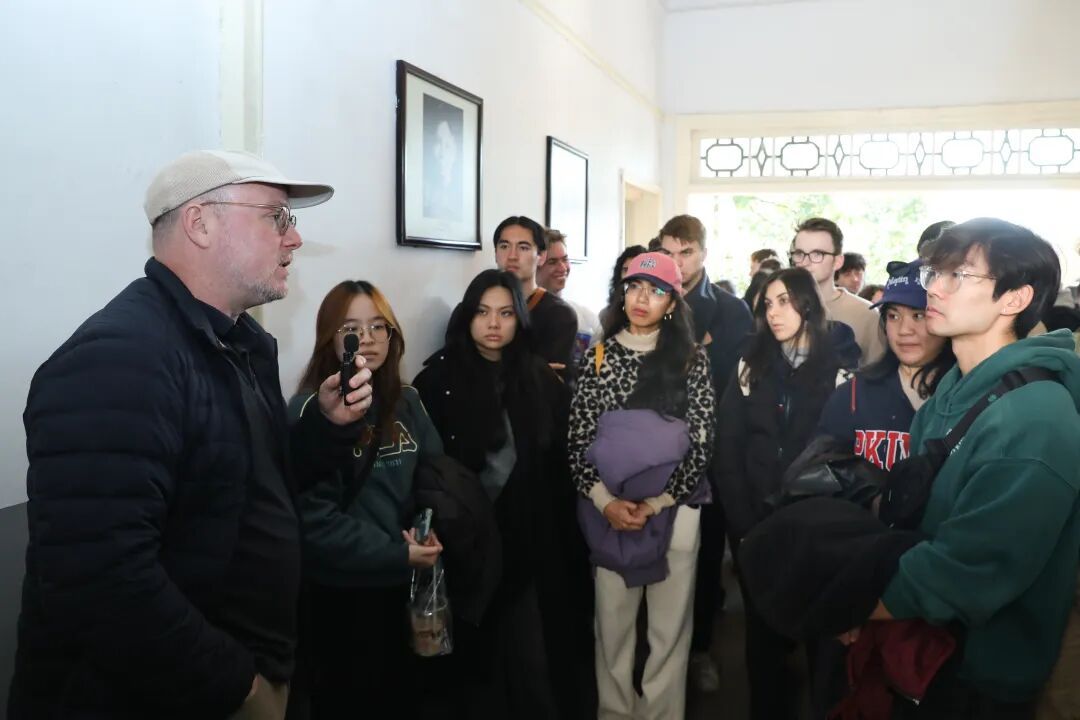
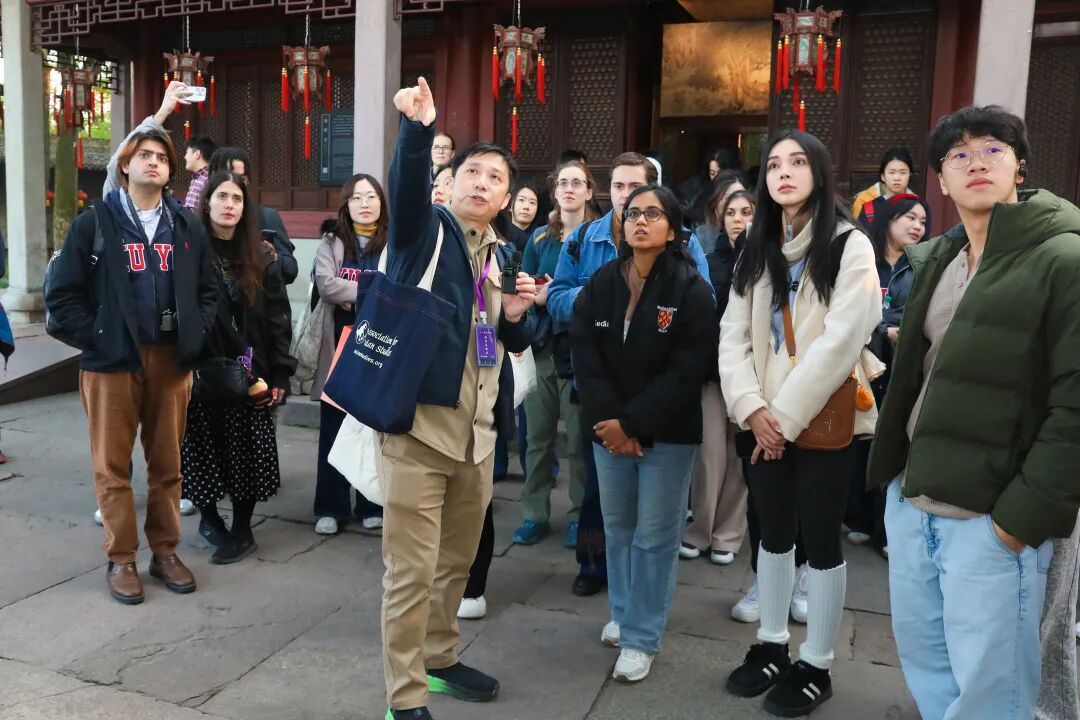
Scholars began their morning with a visit to Lingyin Temple, one of China’s oldest and most significant Buddhist temples. Building on insights from Professor Lu Yang’s lecture, they explored the temple and Feilai Peak, observing its intricate architectural details and gaining a deeper understanding of the spiritual traditions and practices preserved there.

(Day 4) Innovation in Action: Robotics, Visual intelligence and sustainable farming
Scholars had the opportunity to explore modern Hangzhou through a series of corporate visits, gaining firsthand insight into the city’s innovative industries. They were divided into three groups visiting: Robot Town Exhibition Hall + Kaierda, Shining 3D + Vision Valley Exhibition Hall, and Cloudnine Information + Vision Valley Exhibition Hall.
At Robot Town, Scholars learned about China’s first innovation hub dedicated to the entire robotics industry chain. They explored industrial robots applied in medical device manufacturing, welding, and emergency rescue. Scholars also interacted with robotic dancers and witnessed sorting robots performing high-speed, precise classification operations, marvelling at robotics’ potential to enhance efficiency and enrich experiences.

At Kaierda Welding Robot, Scholars visited the exhibition hall and workshop, observing robots handling and assembling automotive components, performing precision welding in electronic metal processing, and conducting efficient inspection and packaging in industries like home appliances, showcasing exceptional automation capabilities. During the Q&A session, they asked about AI’s influence in the robotics field.

At Shining 3D, Scholars explored the transformation of 2D designs into 3D objects, observing prototypes and advanced scanning machines used both in the medical industry and entertainment sector. The visit concluded with a Q&A covering topics from globalisation and political challenges to research and development hurdles and plagiarism.

The Vision Valley Exhibition Hall offered a comprehensive overview of visual intelligence technologies. Scholars experienced products ranging from security cameras to self-driving trucks and engaged hands-on with prototypes, gaining insight into practical applications and how the company is shaping a smarter, more efficient future.
At Cloudnine, Scholars observed firsthand how cutting-edge artificial intelligence is transforming technology and everyday life. They learned with research and development centers in both Beijing and Hangzhou, the company has distinguished itself among information technology enterprises through its exceptional R&D capabilities. Driven by a keen interest in AI, the students observed the company’s scientific research achievements up close. GPU servers, storage servers, and various AI computing components showcased Cloudnine’s continuous technological breakthroughs.
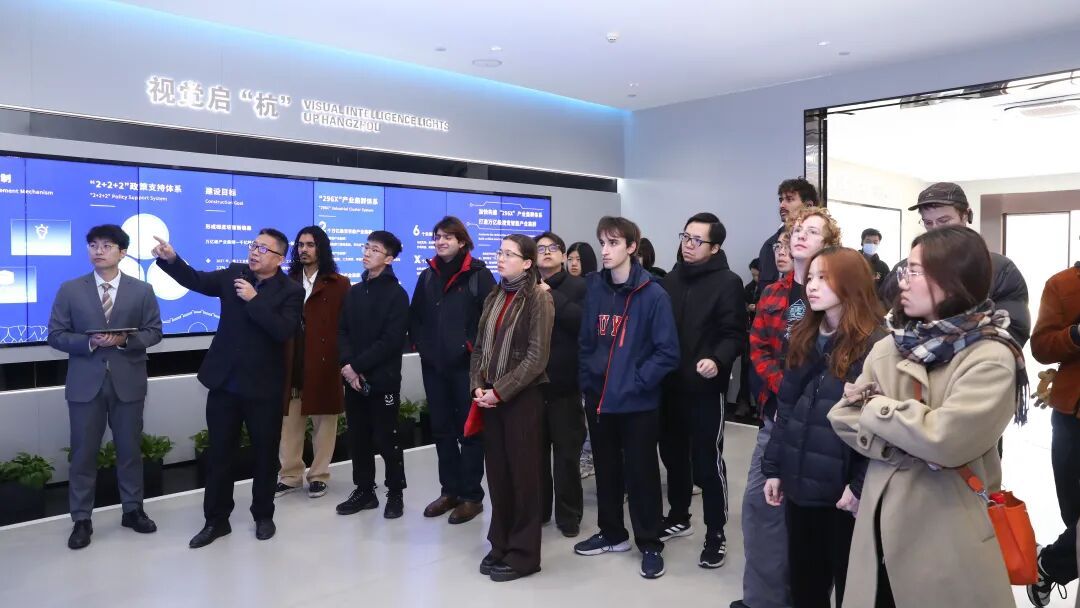
The day concluded with a visit to 4D Bios, a virtual indoor farming base, where CEO Dr. Chen Qing presented the company’s mission to addressing modern agricultural challenges and food security. Scholars participated in a Q&A session covering topics from the preservation of traditional farming practices to company growth strategies. They also had the chance to sample 4D-grown strawberries and tour the factory producing the indoor grow containers.

(Day 5) From Xikou to Xuedou: Discovering Ningbo’s Cultural and Natural Heritage
In Ningbo, the Scholars deepened their journey through Zhejiang with a day devoted to the Chiang family’s historical legacy and the serene landscapes of Xuedou Mountain.
At Xikou, closely associated with Chiang Kai-shek, the group gained a comprehensive understanding of the Chiang family’s role in modern Chinese history. By visiting the family residence and its surroundings, Scholars were able to explore the life, influence, and historical context of one of the era’s most prominent figures.
In the afternoon, they continued to Xuedou Mountain, a destination celebrated for its natural splendour and cultural significance. Wandering along its scenic paths, they encountered striking vistas, tranquil forests, and notable landmarks. The experience offered both a moment of quiet reflection and a deeper appreciation of the mountain’s enduring importance to Zhejiang’s cultural landscape.

(Day 6) Innovation to Heritage: Ningbo’s Modern and Historical Highlights
Exploring the global reach of Chinese innovation, Scholars had the opportunity to visit Zeekr, a leading electric vehicle company. At the Zeekr factory, they learned about the detailed design and manufacturing processes behind the company’s advanced vehicles. The visit highlighted the role of technology in shaping a greener, more sustainable future for the automotive industry.

Next, Scholars visited LUO Music Corporation, the manufacturer of Pleyel pianos, historically associated with Frédéric Chopin. At the factory and warehouse, they observed the transformation of spruce wood into finely crafted pianos, witnessing the care and precision required at every stage of production. Scholars also had the chance to test the pianos and ended the visit with a showcase, demonstrating their own musical talents.

The day concluded with a cultural exploration at Tianyi Pavilion, the former home of Fan Qin and one of China’s oldest private libraries. Surrounded by its extensive collection of ancient books and beautifully preserved traditional architecture, Scholars reflected on Ningbo’s rich historical and cultural legacy.
Conclusion
The week in Zhejiang offered Scholars the opportunity to engage deeply with the province’s cultural heritage, historical depth, and rapid technological transformation. From observing the global reach of China’s innovative industries to encountering ancient artifacts preserved in renowned museums, the field trip highlighted the dynamic relationship between continuity and change that characterises contemporary China. Through a wide range of immersive activities; from visiting creative enterprises, experiencing forward-looking agricultural practices, and witnessing pioneering sustainability efforts, Scholars broadened their academic perspectives and cultural understanding.
This journey, filled with discovery and thoughtful reflection, really emphasised how the past and future remain closely intertwined. The experience will inspire Yenching Scholars to strengthen global dialogue and actively contribute to a world shaped by cooperation and shared vision.