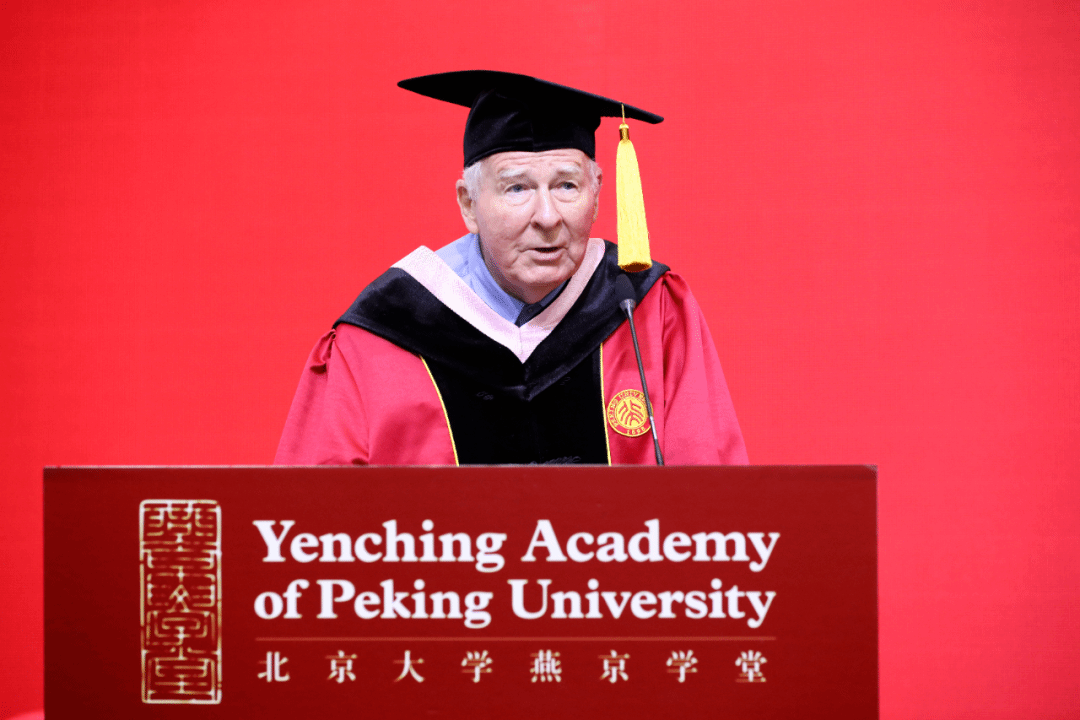
On this happy morning, as I look into the young faces of this year's Yanjingxuetang graduates, I must say you are looking good, very good indeed. And as an educator, it gives me enormous pride to have been part of your Beida experience. As a faculty member at Beida, I have since the introduction of YCA worked with many students from earlier cohorts in my graduate seminars. Over these years, I have served as a faculty advisor for YCA, and perhaps my greatest joy has been the opportunity and the privilege of supervising many MA theses—on an average I would guess, two or three a year.
As a population, you are a potent mixture of international students—with an emphasis on “international” (more than 30 countries and regions)—complemented by a considerable number of students coming from the different and distant provinces of China itself. Having taught for decades in Beida’s International Summer School that, early on and deliberately, established this same kind of student profile, international and local, I have always thought that this kind of local/global diversity is the best shot for everyone. And I say that you are a “potent” mixture because, in the time you have shared together, I fully expect you have learned more from each other, than from any particular faculty member.
In looking at you, I think back to my own student days. I first came to China in 1966 as an exchange student at two of the colleges that have now become the Chinese University of Hong Kong, and as a vacuous and decidedly uninteresting poet-wanna-be, I was in search of the passion and adventure that would make my poetry worth reading. It was an exciting time for me as a young man, perhaps the most exciting time of my life. And as you might infer from this old man, still in China, standing in front of you today, the impact of that special year changed everything.
You can certainly be proud of your hard work, and of what you have been able to accomplish in your experience at YCA. At the same time, as you walk out of the gates of Peking University and go in your many different directions—some to further graduate education, some to internships, some to regular employment, some to entrepreneurial start-ups, some to government posts—I know that you are, in this moment, looking backward and forward at the same time. There is real exhilaration, perhaps with a touch of anxiety, at the prospects and the challenges as the next chapter you have chosen opens up before you. But there is also a profound sadness that this chapter in your life and your experience with these people around you, is coming to a close. What is this visceral feeling you are having right now, and where is it coming from?
My own take-away from China a lifetime later is simple. The story of China is family. Family is where, in the ancestral sacrifices and the oracle bones that remember these communal events, the Chinese written language itself is born. Family is China’s conception of the political—jia, guo, tianxiatonggou 家国天下同构. Family is the governing cultural metaphor (dajia 大家, guojia 国家, renjia 人家, zhexuejia 哲学家). And from ancient times that are still very much with us today, xiao 孝 or “family reverence” has been China’s prime moral imperative.
Michael Walzer at Princeton is one of the world’s foremost political theorists. He is a cultural and political pluralist, and in his small monograph, Thick and Thin: Moral Argument at Home and Abroad, he celebrates those “thick” cultural differences that are very much with us in this room today: Islam, Christianity, Shintoism, Ubuntu, Judaism, Hinduism, Confucianism, perhaps Liberalism (?), and so on. That we differ from each other is a given, and it rewards us with an interesting variety. But when we take the opportunity to activate these same cultural differences for each other, and to make a difference in so doing, we achieve a vibrant and vital diversity.

While Walzer certainly sees the depth of our difference as an opportunity, these same differences also generate the tensions and misconceptions that fragment us and make us many. He thus goes on to ask if there a minimalist morality implicated in each of these thick cultures that far from being superficial, is visceral and “close to the bone.” Is there a “thin” morality that will enable us to find consensus, literally, “a shared feeling,” that can bring us together with that sense of human solidarity necessary to make of the many, one? Can we be one and many at the same time?
Walzer is a liberal, and his answer is to the question of a minimalist morality is “a garden variety conception of justice.” And I don’t think he is wrong. The pursuit of social justice is to endorse liberation from caste and privilege, from class and gender inequities, and to insist upon racial equality. It brings with it a robust conception of human rights, and the transparency and rigor that comes with the Enlightenment celebration of reason. But from a Confucian perspective, we might have to take a step back from Walzer’s conception of justice, and allow that even more fundamental than a sense of justice, perhaps more fundamental than reasoning, than thinking itself, is family feeling (qinqin, qinqing). Indeed, for this Confucian tradition, the sense of “justice” and the values that align with it, are learned in the schoolhouse of the family.
Upon entering into China’s past, certain major themes emerge as they are repeatedly expressed in different facets of Chinese life. One of these themes since at least the early Neolithic period is the centrality of the family that has thoroughly permeated the socio-political, economic, metaphysical, moral, and religious dimensions of Chinese history. If we begin from the fact that the population of China is as large as the continent of Africa and almost twice that of a combined eastern and western Europe, we can appreciate the scale of the diversity that has been pursued over millennia among so many disparate peoples, languages, ways of life, modes of governance, and so on. While this diversity is truly profound, there seems to have been enough of a shared minimalist morality to hold it together as a continuous Chinese history and civilization, for four thousand years and counting.

Going beyond the specifically Chinese historical experience and its values, what is the argument that family feeling as being more fundamental than Walzer’s notion of justice can in fact be universalized to serve as the minimalist morality needed to secure a planetary commons, to enable us to be one and many at the same time? While family has been a dominant value within the Chinese experience, in making an argument for family feeling, Confucian philosophy is to be taken as only one example among many others that could be drawn from the full spectrum of the world’s thick human cultures.
What makes family an important candidate for a minimalist morality and leads us in the direction of a concrete universal is the fact that the seminal role of this institution in all human activity is not in any way exclusive to the Chinese tradition. We don’t need Confucian missionaries to persuade Italian Catholics or West African adherents to their Ubuntu values that family is important. Indeed, families have been a source of economic strength and security in virtually every human culture, and in the absence of any viable alternative to family, will arguably always remain such.
Going back to my question: What are you feeling right now? I suspect as you look around you, the sensation is not too far away from family feeling. YCA is a decidedly family experience, certainly with the ups and downs of family feeling, and not always easy, but it has been deep and important. When, as the years slip away, you think back on your YCA years, and when sometime you come back to visit, you will always be coming home.