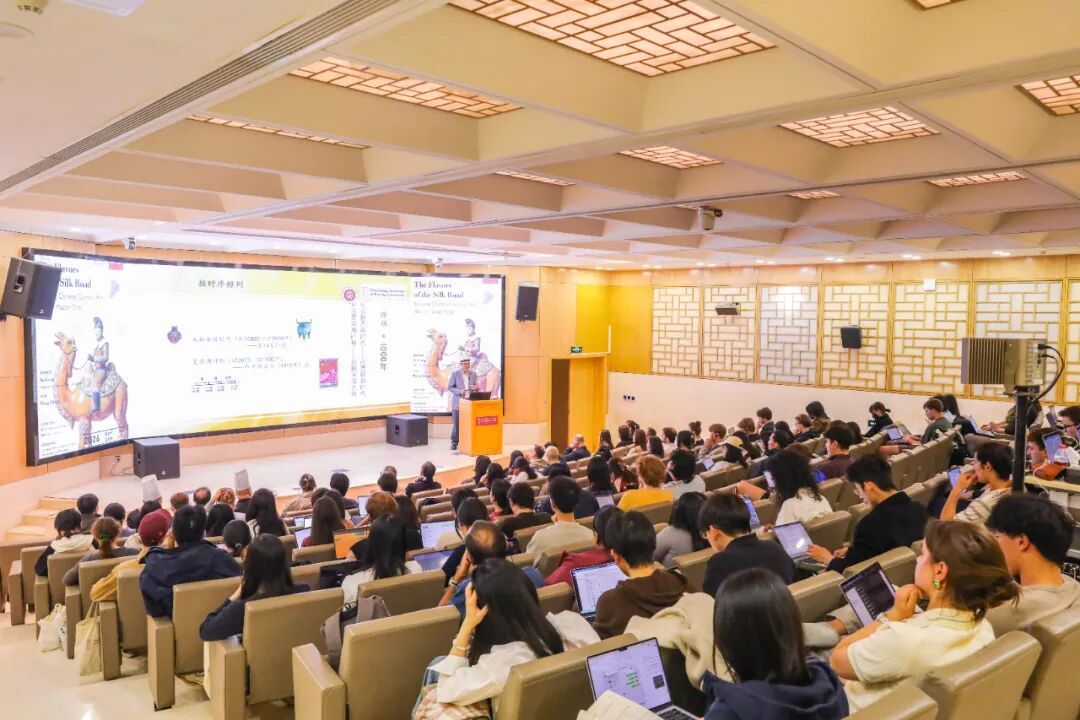
On April 15, Xu Long, a member of Club des Chefs des Chefs (CCC) delivered a lecture titled “The Flavours of the Silk Road: Explore Chinese Culinary Art with a Master Chef” at Yenching Academy. In addition to the distinguished CCC membership, Chef Xu, who served as the Western Cuisine Executive Chef at the Great Hall of the People, is also recognised as a National Technical Expert and Chinese Culinary Master. This lecture was the tenth one in the China Studies Lecture Series for the 2025‒2026 academic year and was hosted by YCA Dean Dong Qiang.

Interview Notes
Before the lecture, Chef Xu Long gave an interview. Over his 40-year tenure at the Great Hall of the People, Chef Xu helmed innumerable state banquets, over which he gained an inerasable muscle memory of ingredients—an asset one could never acquire from books. This distinct muscle memory enables him to feel the differences in texture between individual pieces of the same fruit and vegetable based on provenance and seasonality, to discern the nuanced aromas of spices shaped by addition sequence and heat control, and to find the perfect combination and balance of ingredients to unlock their best. On his field trips to the places of origin of spices and ingredients, Chef Xu gained rich natural history observations and raised questions generally ignored in academia: Why did the foreign ingredients introduced via the Silk Road manage to take root in China? How were they accepted, adopted and adapted into Chinese cuisine and taste? And what do they mean to us today? For Chef Xu, “history means the past, while the kitchen brings in the warmth of life.” The rich experience accumulated and tempered over decades at the wok has distilled into reliable sensory intuition that Chef Xu leverages when analysing a food chemical profile.
In Chef Xu’s eyes, the Silk Road is also the Road of Ingredients and Flavours. He noted that every foreign-origin ingredient, including wheat, lotus roots and ginger, has a legendary journey to China. Over millennia, Chinese people have ingeniously adapted “the foreign ingredients” to their cuisine and taste. “Ingredients were introduced to China via the Silk Road, and flavours of the ingredients have been an issue for culinary culture”. China has been both a receiver of foreign ingredients and a disseminator of adapted foreign-origin ingredients. Foreign ingredients were largely first introduced to China as imperial tribute, exclusively enjoyed by the emperor and his inner circle. As time passed, more foreign ingredients entered China and reached ordinary households. From the upper class down to the grassroots, foreign-origin ingredients and flavours were progressively accepted, adapted and even recreated by the Chinese, providing historical descriptions—which were sometimes more reliable than those in script of how civilisation met and mingled. Chinese cuisine and culinary culture have been seasoned and enriched by the ingredients introduced via the Silk Road, and in turn, have fed back into the world.
From his career path and personal experience, Chef Xu drew key takeaways on interdisciplinary learning for the Scholars: First and foremost, is to gain a foothold. For him, it’s ingredients, with which he strings together culinary know-how and knowledge that extends beyond the kitchen. Next is to give equal weight to theory and practice. “Books give you the height of thinking. Fieldwork brings you the horizon of reality. And with your hands, you may fumble first but ultimately forge precision.” Finally, Chef Xu advised the Scholars to stay curious and stay rigorous, because a true crossover is never casual: “Being interdisciplinary is to understand the world as it truly is.”
Review of the Lecture
Chef Xu Long’s lecture unrolled the four millennia’ history of ingredients-dissemination along the Silk Road. In 1877, German geographer and geologist Ferdinand von Richthofen coined the term “Seidenstrassen” (the Silk Road), while the maritime counterpart was conceptualised by French sinologist Édouard Chavannes in 1913. Academically, the Silk Road is defined as a network of interconnected arteries, including the Oasis Silk Road, Steppe Silk Road, Southwest Silk Road, Northeast Asian Silk Road, and Maritime Silk Road. Along the Silk Road, civilisations met and mingled, and food came first.
Chef Xu introduced the 161 foreign-origin ingredients that entered China via the Silk Road, categorising them into three groups, according to their eastward routes: the Prehistoric Silk Road, the Overland Silk Road, and the Maritime Silk Road.

The Prehistoric Silk Road refers to the trade and exchange networks across Eurasia that predate the Silk Road during the Han dynasty. Over the centuries contemporary with China’s Xia, Shang and Zhou dynasties, Scythians and other nomadic peoples opened steppe routes across Eurasia, through which 28 ingredients entered China. Camels reached China’s northwest from North America by crossing the Bering Strait land bridge, and the imperial chef in the Cao Wei palace developed an iconic delicacy—braised camel hoof broth. Donkeys, indigenous to Africa, served as major pack animals for overland transport in ancient China. Moreover, donkeys are considered a delicacy in China, even compared to dragon meat from heaven. With wheat, cattle, horses and sheep introduced to China, all originating from West Asia, the agricultural landscape was reshaped, and Chinese people renewed their imagination of a plentiful life—foreign-origin domestic animals were added to the scene, alongside the five grains native to China. Ginger, cinnamon and radish arrived in China via India and Southeast Asia and became the foundational flavours in Chinese cuisine. The ingredients coming from afar have integrated themselves into and changed the country’s soil, table and culinary culture, quietly yet persistently.
Zhang Qian opened the routes to the Western Regions, ushering in the “Golden Age” of the Overland Silk Road. The Hu fashion, foreign-origin, surged eastward into China, spearheaded by the 56 foreign-origin ingredients, largely named with the character “hu”, such as cucumber (hugua), sesame (huma), coriander (husui), walnuts (hutao), and pepper (hujiao). Shi Le, the founder of Later Zhao was of a Jie origin, which was by tradition regarded as Hu, a derogatory Chinese term meaning “barbarian” and referring to people from the Western Regions or the northern steppe. Shi Le naturally disliked the term, and consequently, ingredients with the “hu” character were renamed. For instance, hugua was changed to huanggua, huma to zhima, and husui to xiangcai. Many other foreign-origin ingredients have become an integral part of Chinese cuisine and culture. Pomegranate serves as a Chinese cultural icon for the prosperity of many offspring. Watermelon was introduced to China’s Central Plains via the Khitan, becoming a summer must-have. Rosemary was a favorite to the Cao Wei elite in the third century, who hailed the spice in poetry. Cumin was first brought to the Xinjiang region, taking root there and being cherished as the soulmate of barbecue. The foreign-origin ingredients enriched the flavours of traditional Chinese cuisine and expanded the vegetable varieties available in the Central Plains, leaping from 21 in the Han dynasty to 46 by the mid-sixth century as recorded in Qimin yaoshu, an encyclopedia of ancient Chinese agriculture.
As the Overland Silk Road declined in the turbulence caused by the An-Shi Rebellion, the Maritime Silk Road rose to occupy the vacancy. Quanzhou in China’s southeast coastal province, Fujian, was among the world’s top ports. Seventy-seven ingredients “sailed” to China on foreign merchant ships and were named with “fan”, “xi” or “yang”, referring to their foreign origins and coming to China by sea. Crops native to the Americas, including chilli, tomatoes, potatoes, and sweet potatoes, profoundly changed Chinese cuisine and the agricultural landscape. Spices like long pepper, nutmeg, white cardamom, and villous amomum fruit perfectly seasoned Chinese braising and medicinal cuisine. Vietnam-origin Champa rice eased the grain shortage in China, while bird’s nest and American ginseng were regarded as valuable nourishing tonics. Named with characters from “hu” to “fan”, “xi” and “yang”, the foreign-origin ingredients were in themselves a concrete history of Chinese-foreign communication.
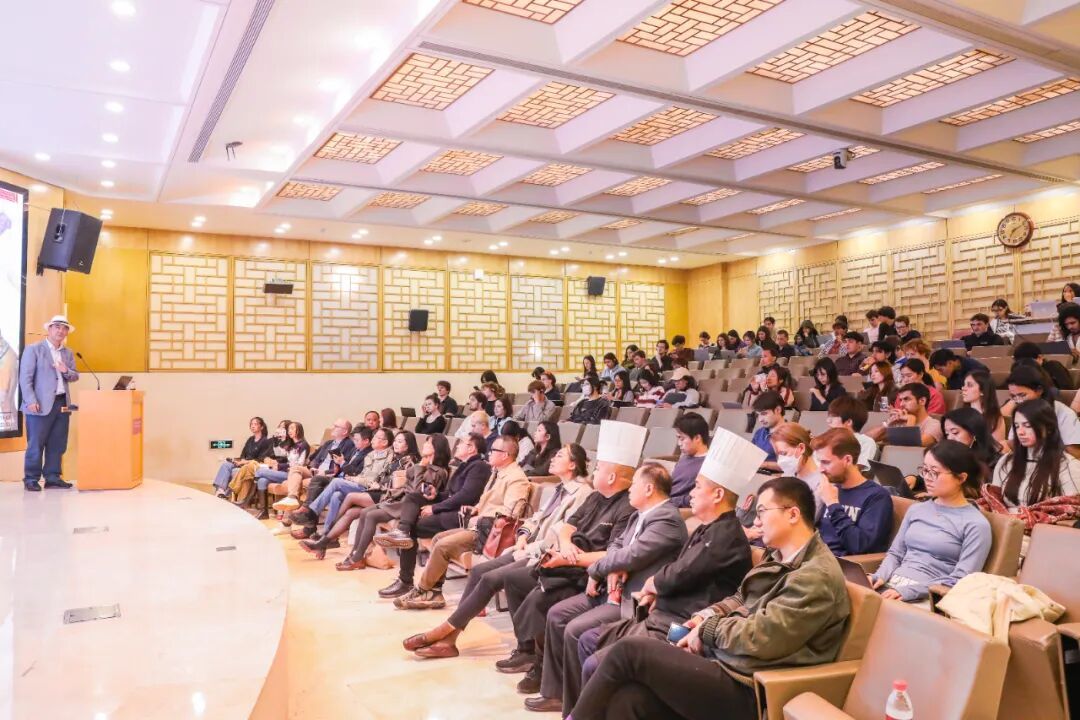
Chef Xu Long valued every foreign-origin ingredient that has integrated itself into Chinese culinary culture. Wheat dominates the north, while rice prevails in the south. With ingredients coming from afar, Chinese cooks developed popular dishes sautéed with coriander, braised in garlic sauce, or tossed in tomato sauce. When the American chilli “married” the Sichuan pepper, native to China, the result was the poignantly numbing Sichuan cuisine. A mirror of the open and inclusive Chinese civilisation, Chinese culinary culture embraced every single foreign-origin ingredient and its distinct flavours and ingeniously adapted them to the Chinese table. In a single dish, we taste and feel the aroma deep from history and from faraway.

Q&A Session
Q: You were the helmsman of state banquets for over 500 heads of state. How did you strike a balance between state banquet protocol and the dietary preferences of heads of state?
A: Before every state banquet, the Ministry of Foreign Affairs provides us a list of dietary restrictions, religious dietary laws and personal preferences of the visiting head of state. We will design the state banquet menu to balance the protocol and dietary requirements, presenting Chinese culinary culture and respecting the culinary culture of the guests. A state banquet is more than a meal. It is a window to our Chinese culinary culture and Chinese civilisation at large.
Q: Why were Americas-origin ingredients able to enter China fast and take root in the country?
A: After Columbus discovered the Americas, European colonists brought crops native to the New World, from chilli peppers, tomatoes, potatoes, and sweet potatoes, to every corner of the world. Such crops are highly adaptable, high-yielding, and easy to cultivate, perfectly suitable for soil conditions and subsistence needs in China. Chilli peppers, for instance, were regarded as an ornamental plant when first introduced to China. However, only 400 years elapsed—a mere blink of an eye if seen in the history of species evolution—before chilli successfully accommodated itself within Chinese culinary culture, making a “perfect match” with Sichuan pepper and becoming “the soul” of Sichuan cuisine. It is a marvellous example of cross-cultural exchange.