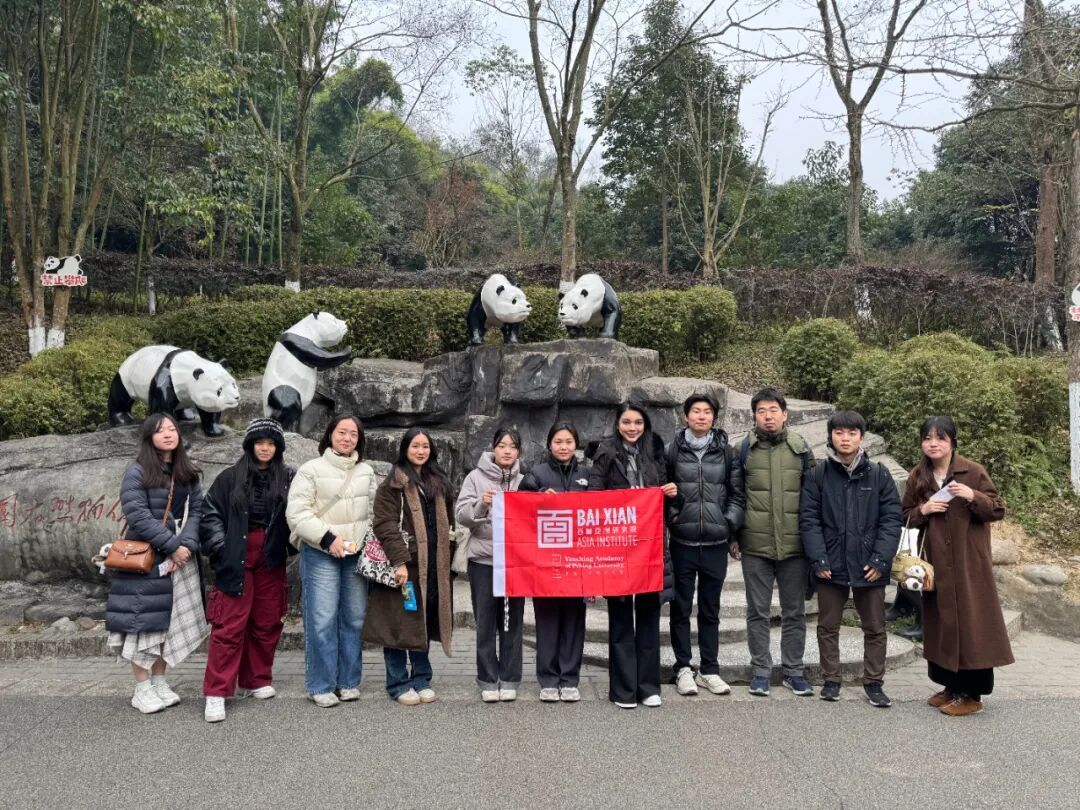
From January 9 to 11, PKU students awarded the Asian Future Leaders Scholarship Program (AFLSP) travelled to Chengdu, Sichuan Province, for a field study trip. The 11 AFLSP recipients, including those from Yenching Academy, School of International Studies, and Guanghua School of Management, delved into the ancient Chinese civilisation and modern Chinese culture rooted in Sichuan. The study trip was organised by Yenching Academy, and the team was led by YCA Associate Dean Fan Shiming and accompanied by YCA Student Engagement Manager Guan Yuxuan.
Visits to the Planning Centre and Companies
On the afternoon of January 9, the PKU team made their first stop at the Future City Experience Centre at Tianfu New Area. The Experience Centre houses a city planning exhibition, an immersive theatre, and an AI experience area, where visitors can understand the New Area’s planning visually and immerse themselves in future life scenarios through naked-eye 3D technology and the Metaverse. The visiting team enjoyed a guided tour by Ye Xiaolin, Director of Investment Promotion Division four under the Tianfu New Area Bureau for International Cooperation and Investment Service and a member of the Party Leadership Group of the City of Future Medicine. Ye introduced the construction planning of Tianfu New Area and of the Chengdu-Chongqing economic circle. The students gained a deeper understanding of the speed of development of the Tianfu New Area.

Accompanied by Ye Xiaolin, the PKU team paid a visit to Tianfu Jincheng Lab, where they were joined by Wu Zhe, a professor at the University of Electronic Science and Technology of China and director of the Chengdu Tianfu Jincheng Frontier Medical Equipment Research Institute. Using cases and statistics, Prof Wu briefed the visitors on the development landscape and prospects of frontier medical equipment in China, particularly advances in its application.

Prof Wu pointed out that the advancement of medical equipment is by no means limited to healthcare in the narrow sense, and extends to a wider array of areas, such as sports science, rehabilitation science, big data analytics, and 5G-enabled remote collaboration. The AFLSP recipients had a fruitful discussion after Wu’s lecture. Itsuki Shimosako, a PKU student from Japan wondered why Chengdu, rather than a south-eastern city, was selected as the base for frontier medical equipment in China. Prof Wu noted that Chengdu is in the southwest China and the research institute based here can better serve the people in western China. Associate Dean Fan Shiming appreciated this visit as a precious experience for liberal arts students, allowing them to have a close look at the scientific research platform and university-industry collaboration in the medical equipment research institute.


Visits to Dujiangyan Irrigation System and the Giant Panda Base
On the morning of January 10, the PKU team travelled to the Dujiangyan Base of the China Conservation and Research Centre for the Giant Panda at the foot of Mount Qingcheng. Fascinated by the giant pandas, the students took detailed notes about the rewilding training and habitat conservation and got up close with China’s beloved national treasure animal.
The PKU team started their afternoon hiking from the Qinyan Tower and were awed by the sophisticated Irrigation System composed of the three main engineering works: the Yuzui Bypass Dyke, Feishayan Floodgate and Baopingkou Diversion Structure. The students gained a vivid impression of the continuous efforts in water conservancy projects and continuity of Chinese civilisation, as evidenced by the four iron bars buried in the riverbed during the Wanli reign of Ming dynasty, the Tongzhi reign of Qing, the republican period and after 1949. The original bars remain in the riverbed, and what is currently on display are replicas. An epitome of harnessing flooded rivers in ancient China, with Li Bing and his son as the outstanding figures, the Dujiangyan Irrigation System dating back over 2,000 years continues to benef a population of around 30 million people in the area. It is the only ancient water engineering project that remains in operation in the world and epitomises the Chinese philosophy of harmony between humanity and nature.

A Dive into the Ancient Shu Culture at Sanxingdui
On the morning of January 11, the PKU team visited Sanxingdui Museum, where they enjoyed a time-travel back into the ancient Shu culture. Hailed as one of the greatest archaeological discoveries of the 20th century, Sanxingdui is an iconic Bronze Age civilisation in the Upper Yangtze region. The enigmatic masterpieces of Sanxingdui highlight the unrivalled craftsmanship and unveil a fantastical civilisation created by the ancient Shu people.

The PKU team had a close look at the national treasures at the New Hall and the Bronze Pavilion of Sanxingdui Museum, while a docent gave a detailed introduction to the items. The massive bronze sacred tree rises four meters high, with dense branches stretching upward and outward, as an embodiment of the ancient Shu people’s awe for and aspiration for the universe. The bronze mask with tubular eyes is a manifestation of uniqueness, and in its enigmatic yet infectious smile, the visiting team marvelled at the ancient Shu people’s aesthetic power. The giant bronze standing figure is clad in a ritual costume with a dragon design and holds a ritual object (which is now missing) in its hands. The towering, majestic-looking figure likely depicts a high-ranking figure in the ritual and power hierarchy of the ancient Shu state. Following the docent, the PKU team took notes about the ancient Shu civilisation, which was unique yet intertwined with the Central Plains culture. One bedrock of the Chinese civilisation, among many others, the Sanxingdui civilisation is a manifestation of “diversity in unity” of the Chinese nation.

Remarks from the AFSLP Recipients
Leung Hoi Ching Natalie (Hong Kong, China, YCA Cohort 2025): The trip provided me with an immersive lesson in history, nature, and human creativity. I gained a new understanding of Sichuan and the culture of the place, and I fully admired every cultural landmark and legacy associated with it.
Jumpei Kasahara (Japan, AFLSP Exchange Scholarship recipient, 2025): In the visit to Tianfu Jincheng Lab, I had a glimpse of the ever-evolving technological landscape of China. Chengdu is a vibrant modern city that boasts a history and culture dating back over 2,000 years. I am particularly impressed by Chengdu’s inclusiveness and its long history.
Asian Future Leaders Scholarship Program (AFLSP)
The Bai Xian Education Foundation (BXEF) was established by Mr. Ronald Chao in 2014 with a mission to fund and support the development of the Bai Xian Asia Institute (BXAI) and the Asian Future Leaders Scholarship Program (AFLSP). The AFLSP aims to foster the next generation of leaders, promote communication and understanding between high-calibre scholars of Asia, and contribute to relationships and coordinated development across Asia and the world. To this end, the Yenching Academy of Peking University arranges diverse extracurricular events for PKU Bai Xian Scholars to create intercultural opportunities for young Asian scholars and build stronger bonds among PKU Bai Xian Scholars and between the scholars and the university.