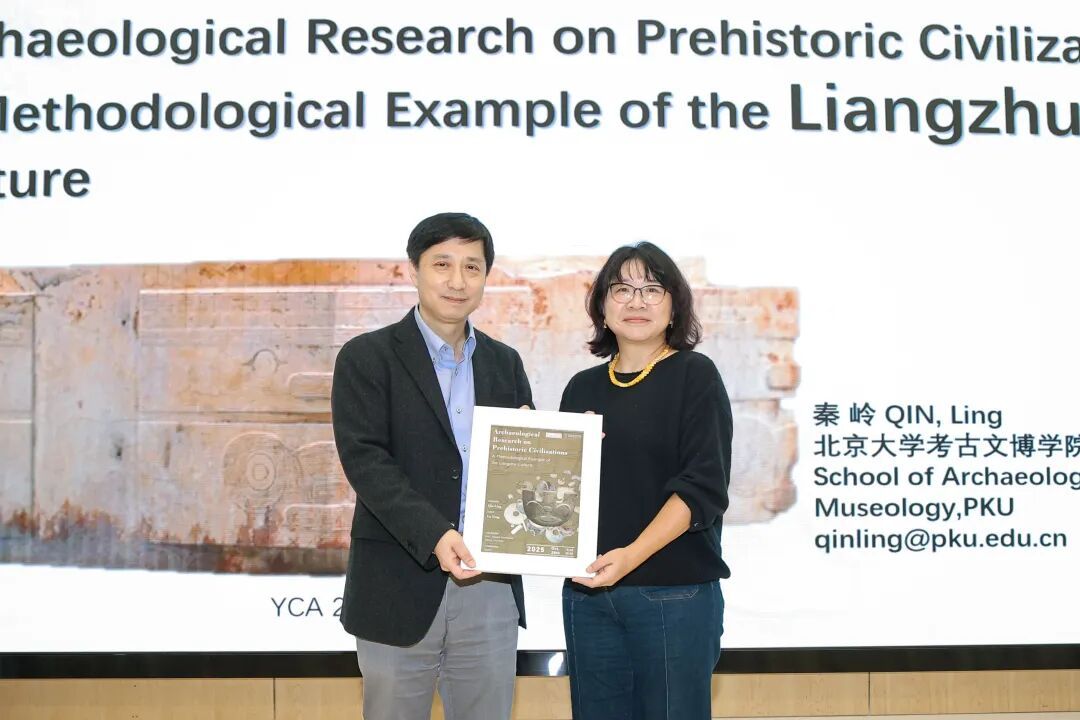
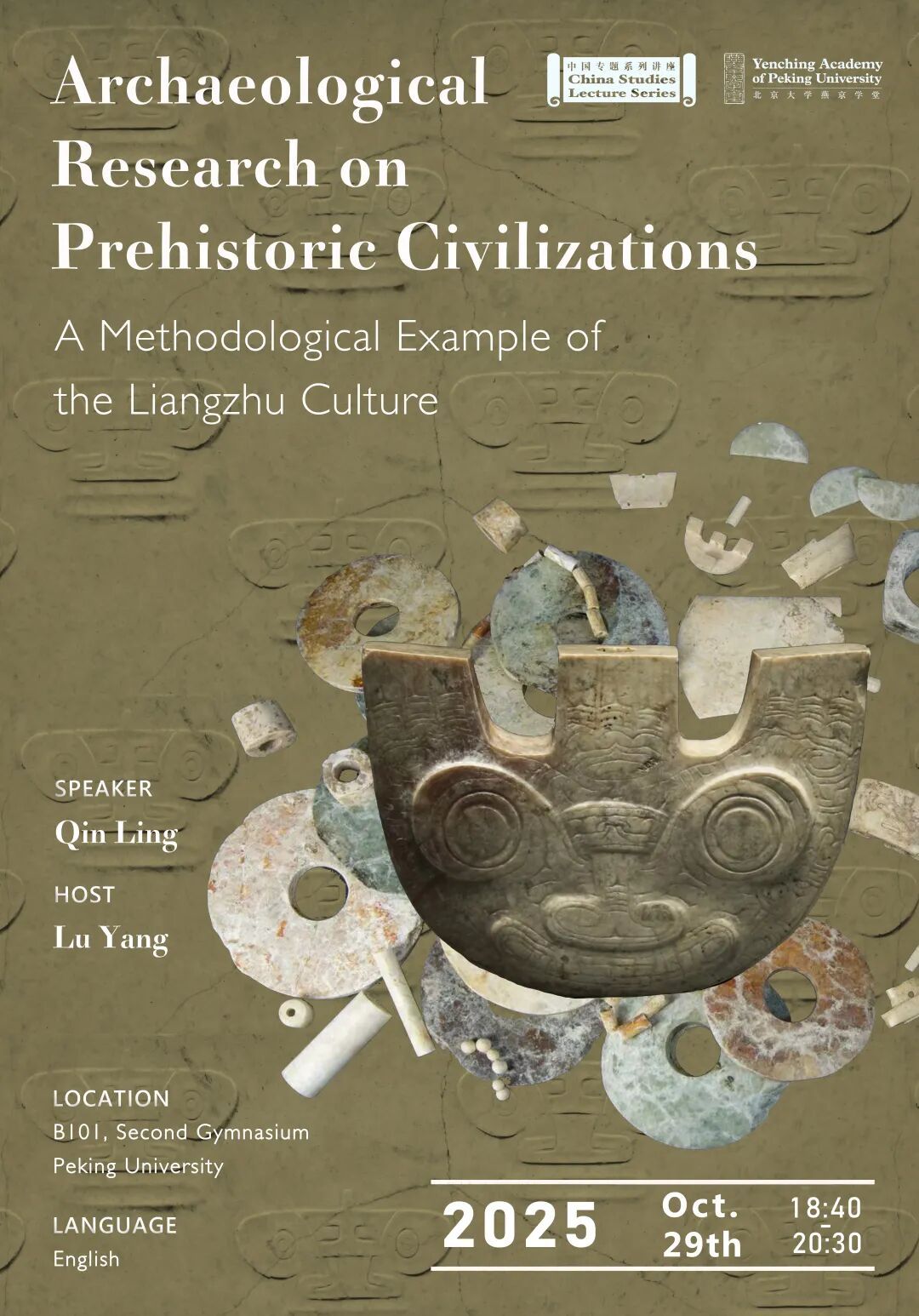
On October 29, Qin Ling, Associate Professor and Doctoral Supervisor at the School of Archaeology and Museology, Peking University, delivered a lecture titled “Archaeological Research on Prehistoric Civilisations: A Methodological Example of the Liangzhu Culture”. This was the sixth lecture in the China Studies Lecture Series for the 2025‒2026 academic year and was hosted by Lu Yang, Director of Graduate Studies of Yenching Academy.
Interview Notes
Before the lecture, Qin Ling laoshi gave an interview. She noted that the Liangzhu jades were finely crafted and highly standardised to fulfill social roles. Jades were used to “construct identity”. The personal jade assemblage told the tomb owner’s ethnic affiliation, gender, and social status, and served as the means to consolidate group identity. The level of craftsmanship functioned as an indicator of social hierarchy, as the social elite had exclusive control over resources and fine techniques. Qin emphasised the role of mysterious patterns and the mask-shaped “Divine Emblem” in forging the common beliefs and a shared worldview among the prehistoric residents in the Taihu Lake region. Jades fulfilled the ritual and spiritual roles in the hierarchical Liangzhu society.
Qin Ling laoshi pointed out that in the long run, AI will be used as an auxiliary tool for archaeology and that AI can hardly be a co-explorer. She underlined two reasons for this. First, every archaeological excavation is a non-repeatable extraction of historical information and leaves irreversible impacts on the object of research. This differs fundamentally from the workings of a big data-based AI model. Also, there is never a sinlge correct answer to an archaeological issue, as scholars from different cultural and academic backgrounds can form diverse explanations and interpretations of the same issue. But unlike humans, the current AI models require definite, positive feedback for learning. Qin Ling laoshi recognised AI’s practical utility in data processing for pottery sherd sorting and pattern analysis, where research efficiency is substantially increased. Yet, AI cannot change the current research paradigm of archaeology and remains merely a powerful tool.
Qin Ling laoshi shed light on the coming field trip to the Liangzhu site. She suggested our Scholars look at the archaeological site from the prehistoric Liangzhu residents’ point of view and think about how prehistoric people were mobilised from long distances to build the massive public works at Liangzhu in the pre-literate era, where means of transport were hardly available. Qin provided a new perspective for understanding the finely crafted Liangzhu jades: If the fine decorative pattens could be hardly seen except by the person who held an object in hands, why did the prehistoric Liangzhu people still bother to make them? She noted that the Liangzhu jades were buried with the dead, thus not designed for the living. Accordingly, Qin invited our Scholars to go beyond their immediate context and understand the Liangzhu jades’ social and ritual roles. She expected personal insights from our Scholars after their field trip to Liangzhu.
Review of the Lecture
Qin Ling laoshi took the Liangzhu culture as a methodological example for the research on a prehistoric complex society in the pre-literate era. She highlighted the distinction between Chinese and Western understanding of “civilisation”. In the Western context, “civilisation” generally evokes ideas of “city” and “citizenship”; while in the Chinese culture, “civilisation” is an idea focusing more one “moral cultivation” and “cultural virtue”. However, in discussion over “civilisation”, Chinese archaeologists follow the international practice to focus on the aspects of such as the structure, complexity and organisational form of society, instead of the singular morals-based judgment. The Liangzhu culture was an exemplar of a highly complex prehistoric civilisation in the pre-literate times.
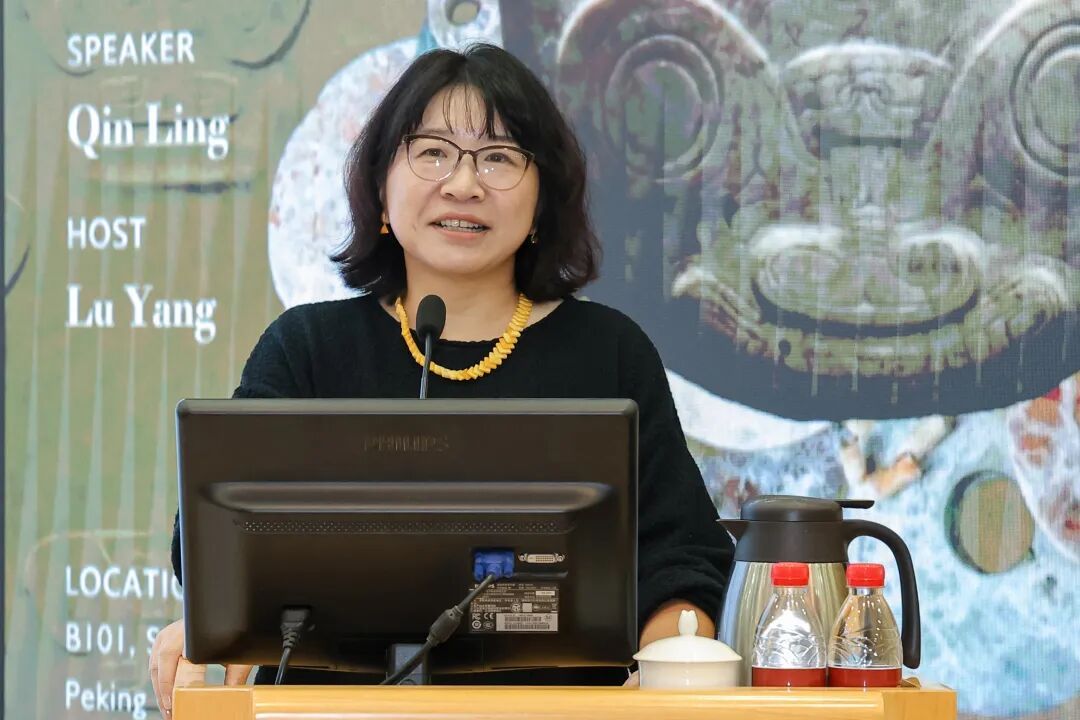
Qin Ling laoshi employed the “Urban Revolution” theory in the Western archaeology to explain why the Liangzhu culture is categorised as “civilisation”. In the meantime, she underlined the limits of the theory. Gordon Childe, the eminent archaeologist who established the “Urban Revolution” theory, was sometimes criticised for his “checklist” approach (such as writing, specialised production, and monumental public works etc.), because the “checklist” was primarily drawn from empirical observations of Mesopotamian and Egyptian civilisations and not all civilisations exhibit the ten criteria on the “checklist”. The Liangzhu culture had no established writing system, and its magnificent public works were largely constructed with rammed-earth techniques, instead of lithic structures. Yet, Liangzhu has been still recognised as “civilisation”. This raises new questions: Does the “checklist” approach fit all prehistoric civilisations? Or should a new framework be constructed based on the specific material remains and material culture for understanding an early civilisation. To this end, Qin Ling laoshi proposed five analytical perspectives: planning and size, public works, level of social stratification, scale of agricultural economy, and specialised craft production.
The core area of the Liangzhu city complex occupies approximately three million square meters, featuring a well-defined layout with outer and inner walls and a complex water management system. The walls and water system constitute a complex network of defence and transportation. Notably, the Liangzhu site is not the geometric centre of the region; instead, it is located at one corner. Qin Ling laoshi maintained that the location held strategic control over and access to jade raw material, which was the key resource for the Liangzhu people. In addition, the Fuquanshan site in Shanghai and Sidun site in Changzhou, Jiangsu province were also regional centres of the Liangzhu culture, revealing that the Liangzhu society was likely a “multi-centred” network of civilisation, rather than a pyramid-structured empire.

The magnitude of public works at the Liangzhu site, from towering platform at Mojiaoshan to massive walls and dams, required huge investment of labour. Thus, by Qin’s calculations, 10,000 labourers must have worked for seven years in a row to prepare the staggering volume of rammed earth alone. If the men only worked in agricultural off-season, the construction could have lasted for decades. There must be a powerful ruling core at the Liangzhu site to mobilise and control such a large-scale labour. Flood control was merely the primary function of the high-dam system at Liangzhu, and beyond that, the Liangzhu dam system functioned for transportation and water management, connecting the capital city with its resource and agricultural zones.
Tombs are an important window to the ancient society. Qin Ling laoshi took the Fanshan Cemetery as an example. There were only 11 tombs at the Fanshan Cemetery, which is recognized as the highest-ranking cemetery of the Liangzhu culture. The 11 tombs were for the highest elite of Liangzhu society and were neatly arranged in rows. Each tomb yielded a large number of spectacular jade artifacts. The arrangement and contents of the tombs stand as a sharp contrast to the common graveyards in village communities. The cemetery is a physical manifestation of social stratification at Liangzhu, where social elite abandoned the kinship-based burial system and adopted one based on social status. The burial jades are a physical testament to a highly hierarchical society.
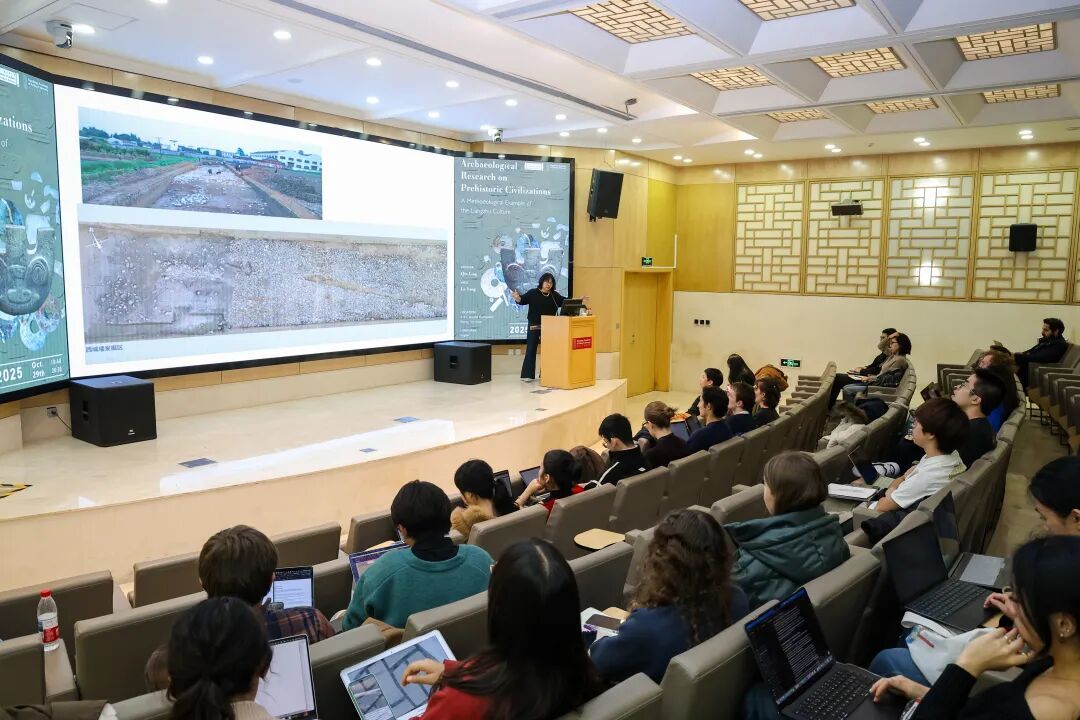
The Liangzhu culture boasted an advanced paddy field agriculture. At the Maoshan site near the Liangzhu core area, there are large fields from the Liangzhu era, clearly defined with ridges and pathways. A large number of stone agricultural tools, including plows and harvest knives, were unearthed at Maoshan, indicating a specialisation of agricultural labour. However, even though no paddy field remains have ever been discovered at the core area of Liangzhu city, the site yielded hundreds of tons of carbonised rice, indicating a redistribution system through which rice was collected and transported to the core area to support the non-farming ruling class and specialised craftsmen.
The Liangzhu culture has left a brilliant jade legacy. Multiple jade workshops have been discovered inside and outside the ancient city. The jade-making techniques at Liangzhu encompassed highly specialised processes, from raw material preparation and drilling to decoration carving, which were organically integrated into a smooth workflow. Jade-making at Liangzhu featured a high degree of organisation and specialisation. The jade cong carved with the deity and beast mask is the iconic artifact of the Liangzhu culture. Its intricate, micro-carved design depicts a deity who wears a feathered headdress and rides a mythical animal. The standardised “Divine Emblem” can be widely seen on the Liangzhu jades and constitute the religious core of Liangzhu society.

Qin Ling laoshi concluded her lecture with a concise summary. The Liangzhu culture stood as an early state which, despite lacking a writing system, created a large city with a complex system of water management, a high level of social stratification, a highly specialised craft production, and a complete ritual system. The prehistoric Liangzhu civilisation evolved in a broader historical context, including its paddy field agriculture and distinctive culture, rather than as an isolated case. The “checklist” based upon Western civilisations may not work for the study of Liangzhu and similar civilisations. We need to focus on the site and remains of a specific prehistoric civilisation and conduct in-depth case studies and cross-regional comparative studies in a holistic manner to understand the diversity of human civilisations.